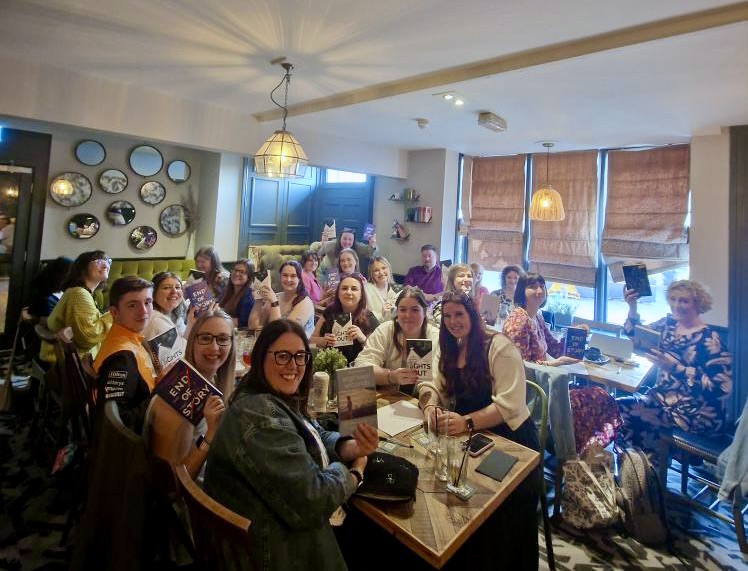
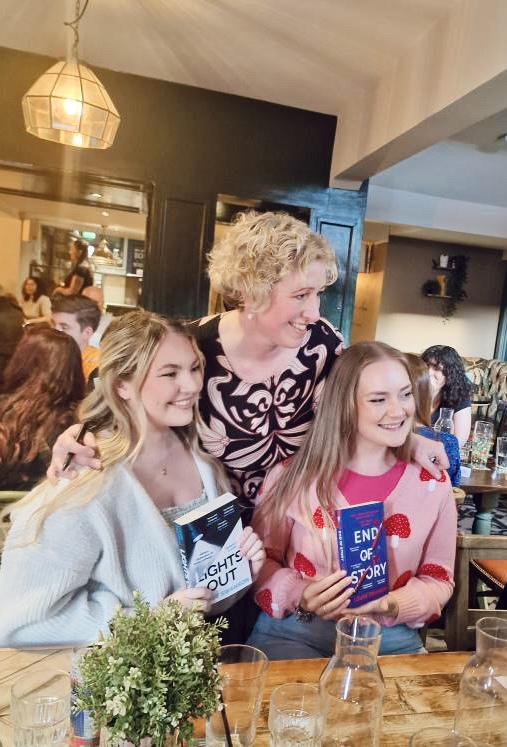
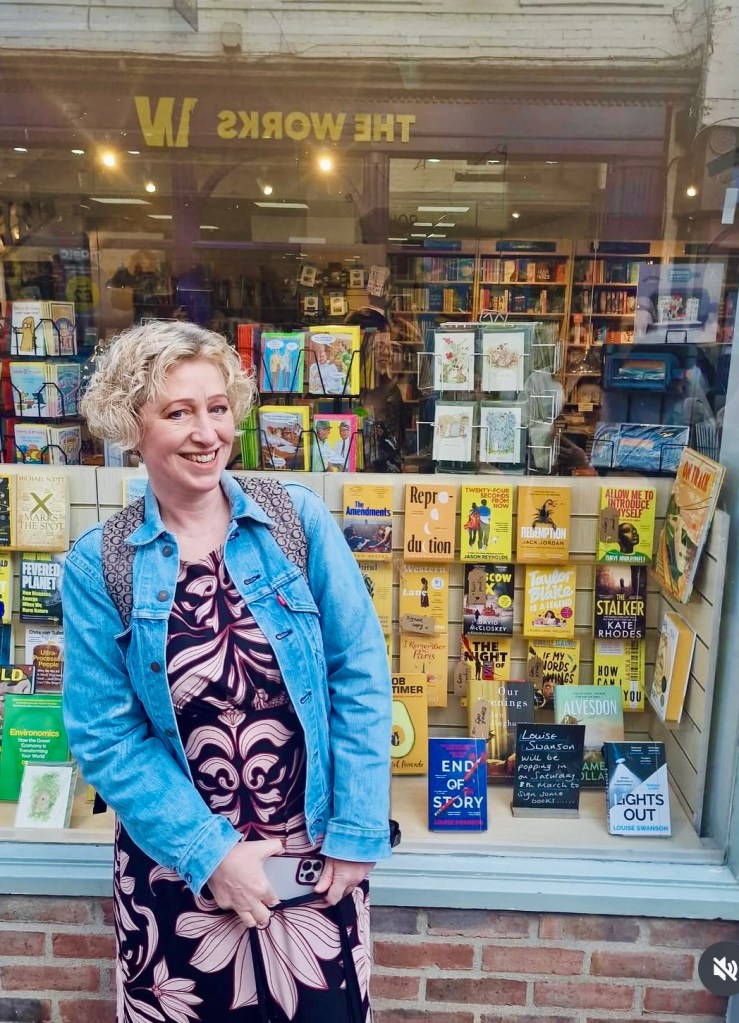
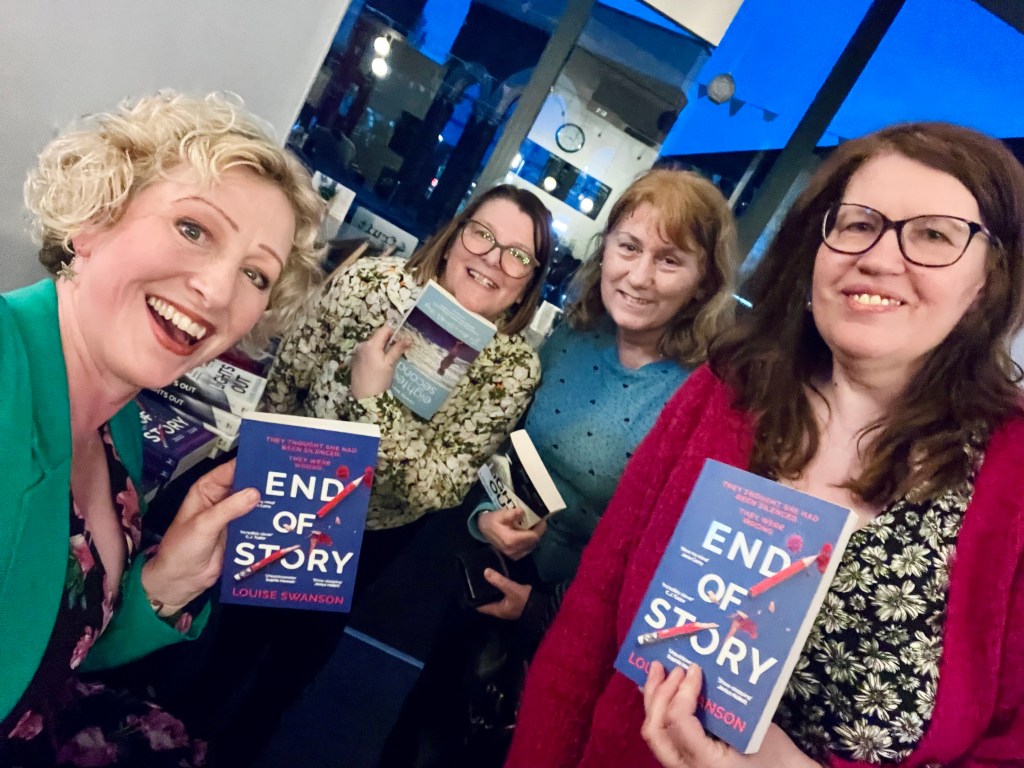
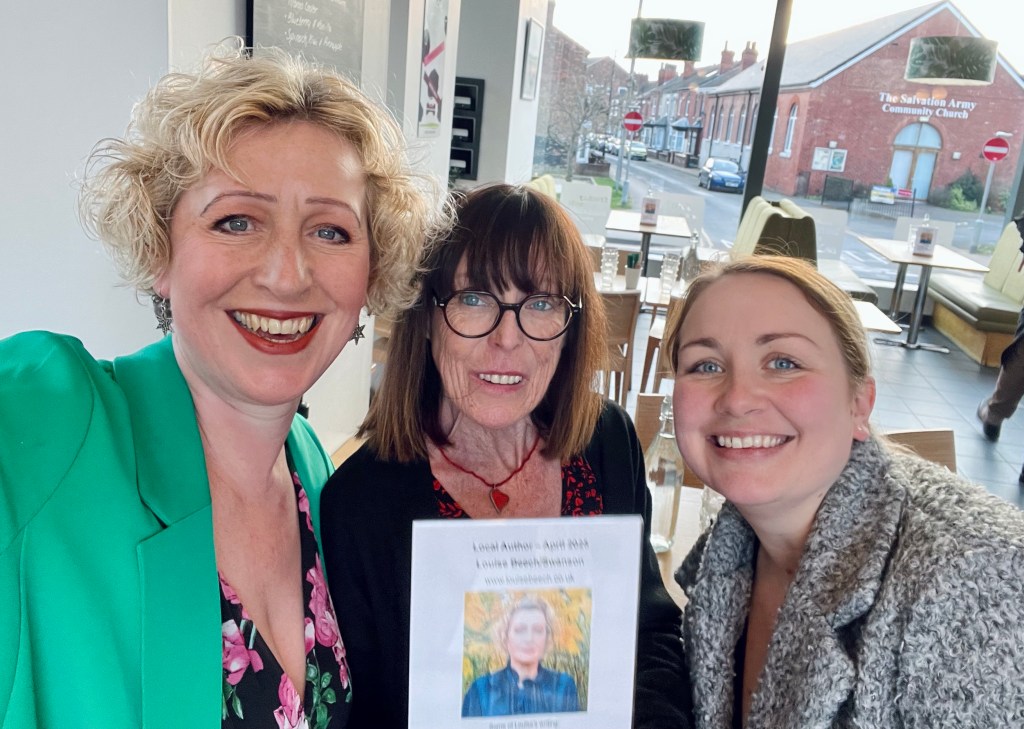
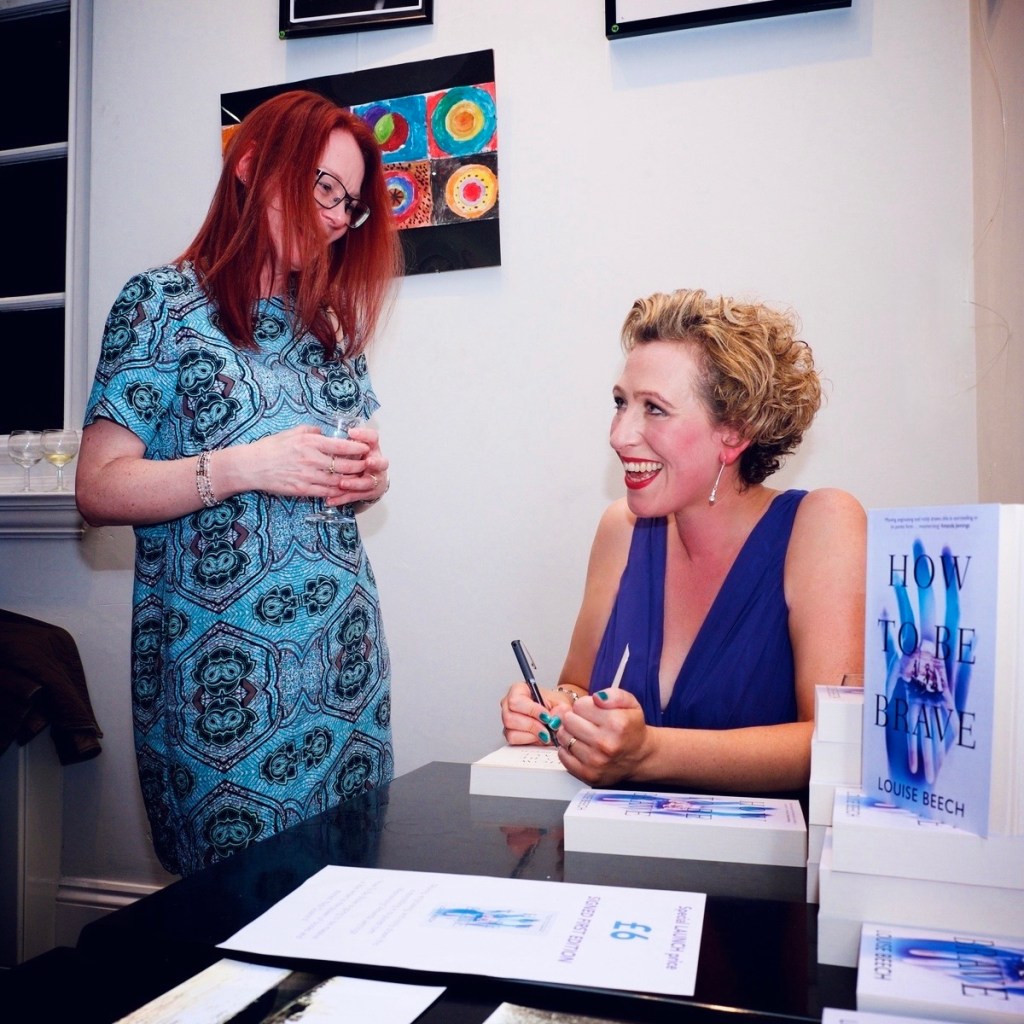
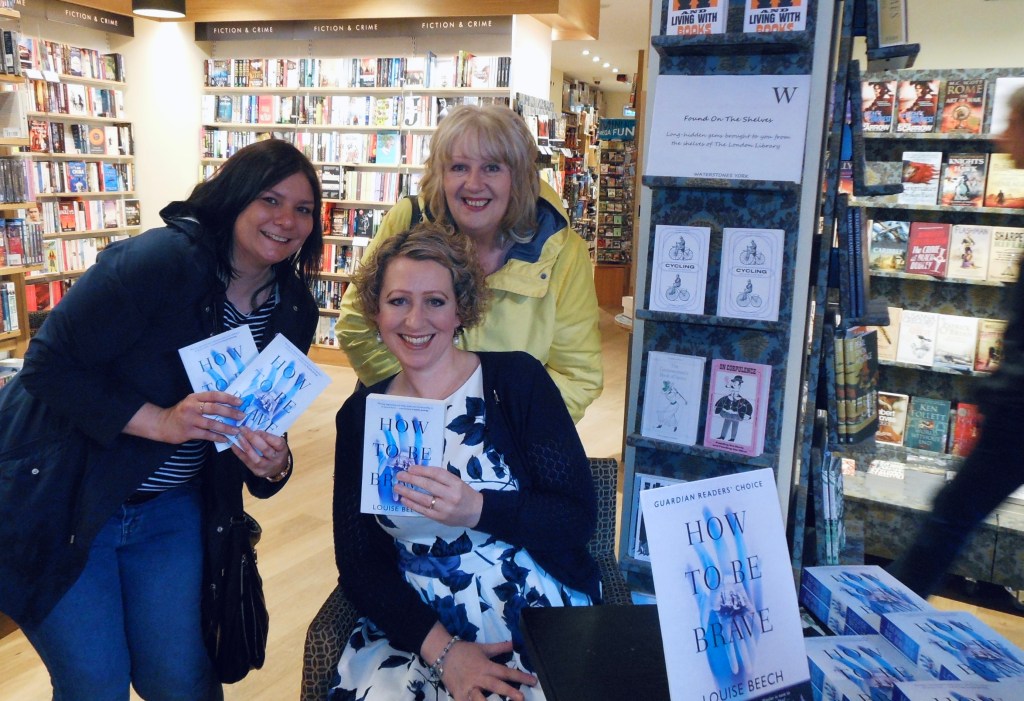
Over the last month, I’ve possibly attended/joined more book groups than usual. I’m not sure why it happened like this? Maybe the culmination of it being the ten year anniversay of first getting a book deal, maybe now having had eleven books published, or maybe just because I’m open (always) to meeting readers old and new. It’s my favourite part of being an author. (Well, aside from the actual writing…) In March I was invited by the brilliant Yorkshire Reads, a HUGE group spread across my great county, to bombard local Beverley bookshops and then enjoy lunch and a bookish quiz. (I’m embarrassed to say I didn’t even get an answer right when it was about my own book!) Each month, they visit a different town to try out new bookstores, and of course buy piles and piles of books.
At Beverley Bookshop…
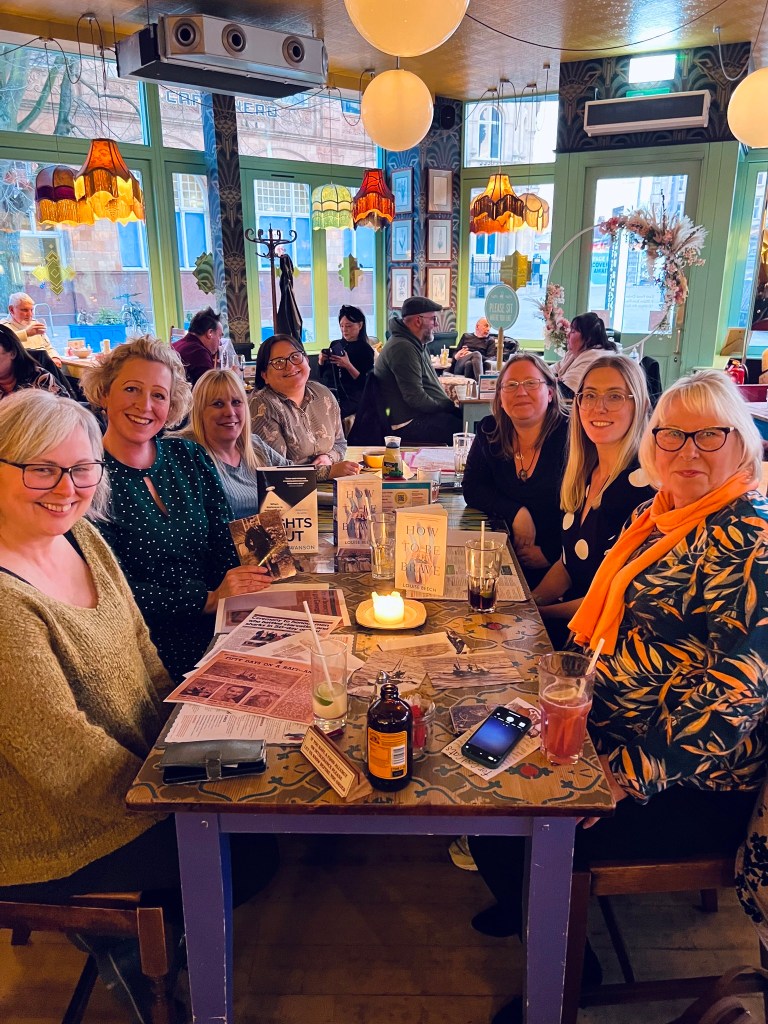
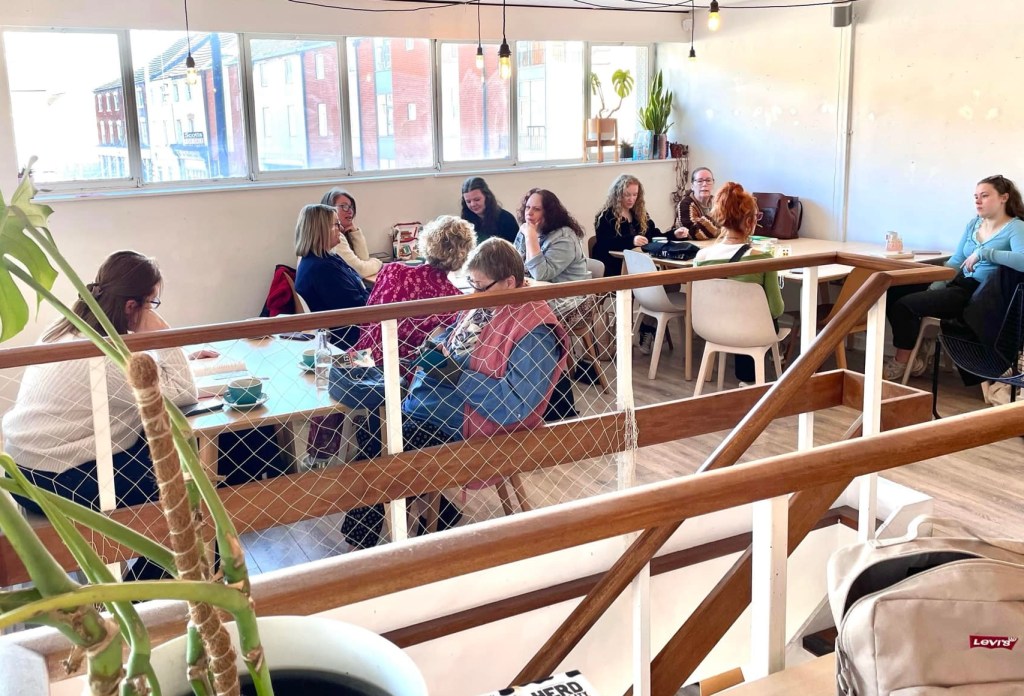
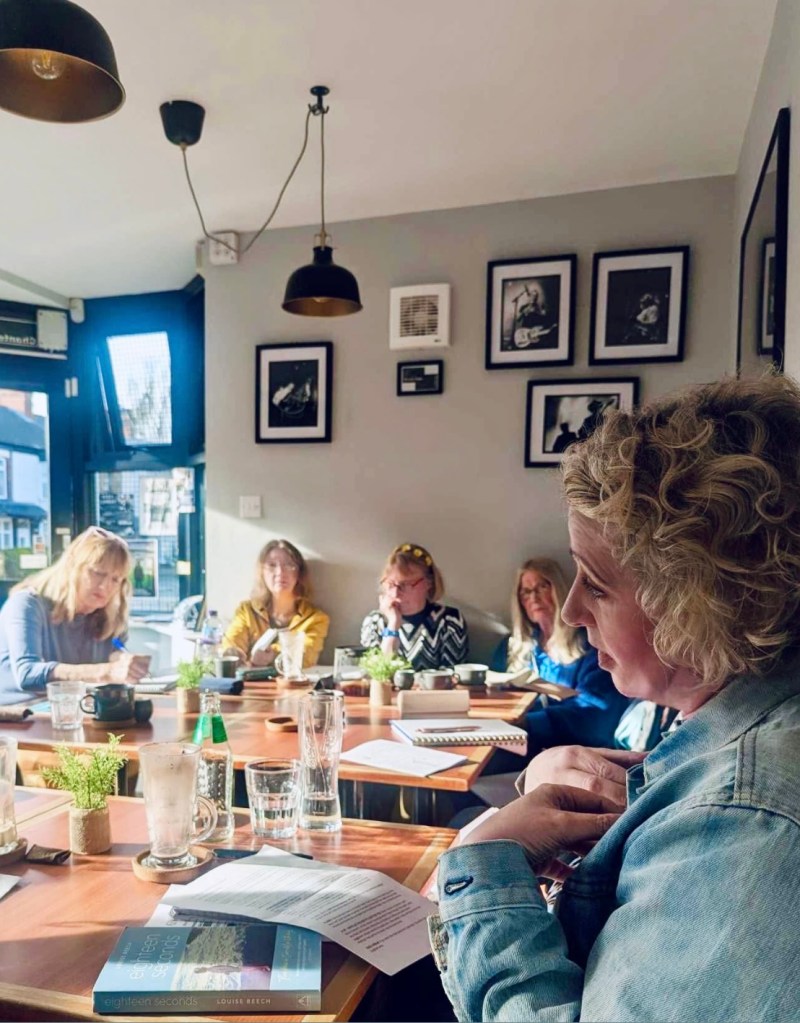
I was also invited to tea with friend Lisa Lee’s work book group in Hull. They had read How to be Brave, my debut, which is a pretty important book for Lisa and I – we both have daughters with Type 1 Diabetes. I took all the pictures and newspaper cuttings I have of Grandad Colin, and it was wonderful to see his survival story then brought even more to life before their eyes. They couldn’t believe how small his lifeboat was. Telling his tale again and again keeps him alive; keeps all wartime tales alive. I also co-hosted anotherly monthly All Write Now with Valerie Valente and Lynda Harrison. At this Hull writing group we do workshops and writing prompts to get the creative juices flowing. This month I shared how I wrote my memoir, Eighteen Seconds. I also joined Hull’s Silent Book Club. Yes, me. Silent. For an hour. Reading with them all. And it was magic.
Sharing how I wrote my memoir…
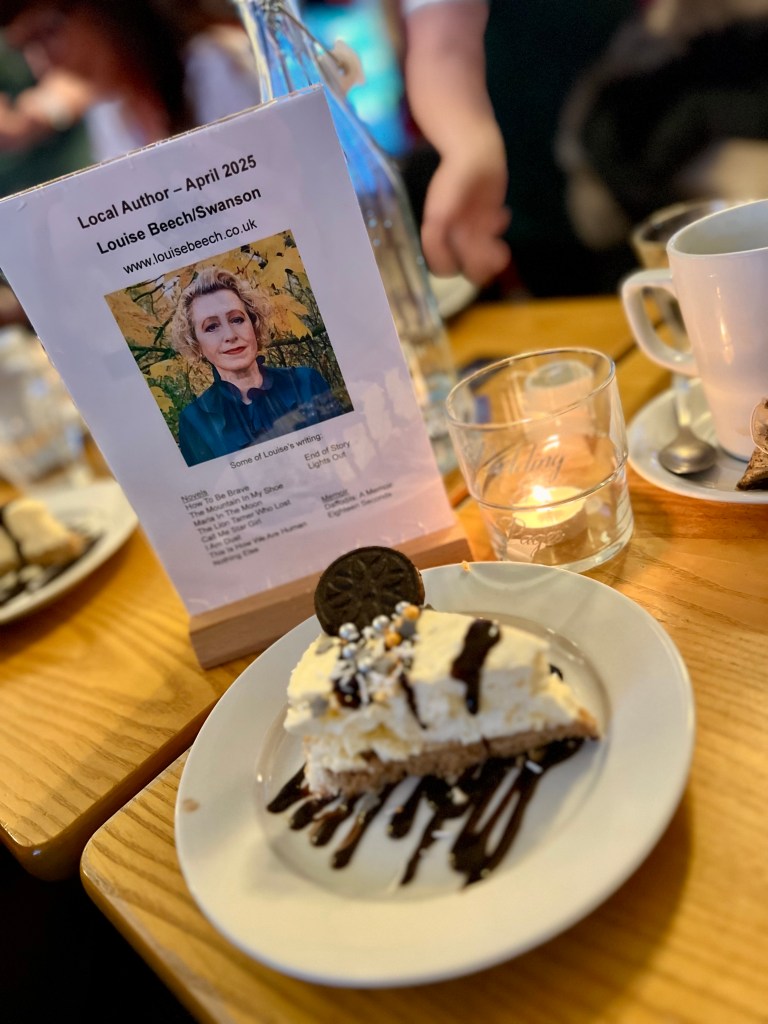
Last week I travelled to Gainsborough to join Pudding and Pages, another large reading group who choose a book to read each month and then meet for dessert to discuss it. How could I say no to cheesecake scattered with space sparkles to celebrate their book choice, Orbital by Samantha Harvey? Friend and passionate book reviewer Anne Cater is a member and it was lovely to see her. The group have chosen Eighteen Seconds as their next read, and there was a powerful moment when a member shared something very painful, feeling it was a safe space, as a result of a question to do with the title. These things tell me I was right to share my story of childhood trauma. Doing so helps others to do the same.
This week I’ll be joining the Hull Waterstones Book Group because they’ve been reading Lights Out. You always hope that they’ve enjoyed it, especially when you’re joining them for the discussion. But that said, I’m a big girl, and don’t mind healthy critique. It’s how we learn and grow. So, honesty is always welcome. After that … watch this space. I’m always open to joining book groups, so just message me. If it’s too far to visit physically, I can always zoom you. Happy reading!
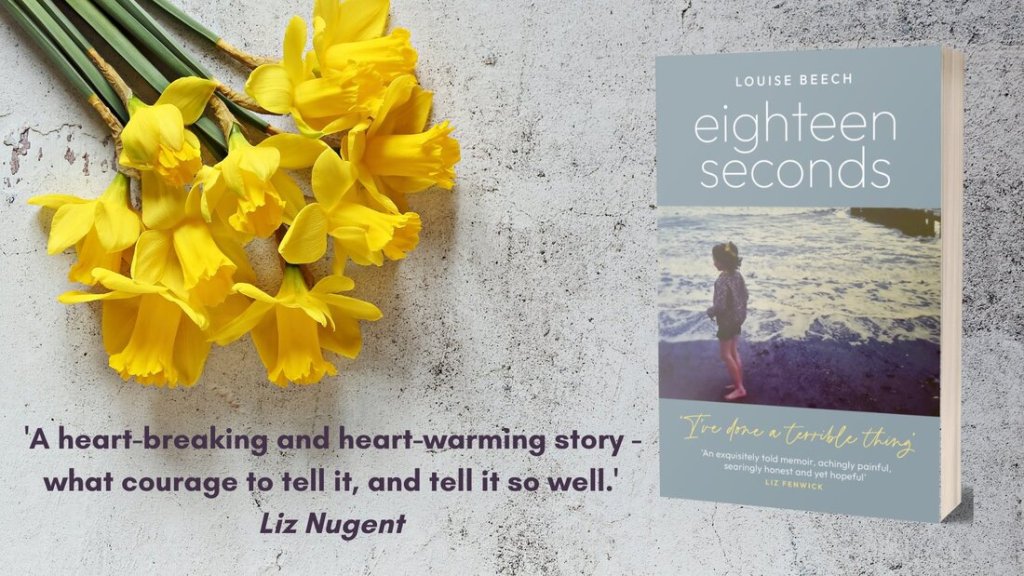
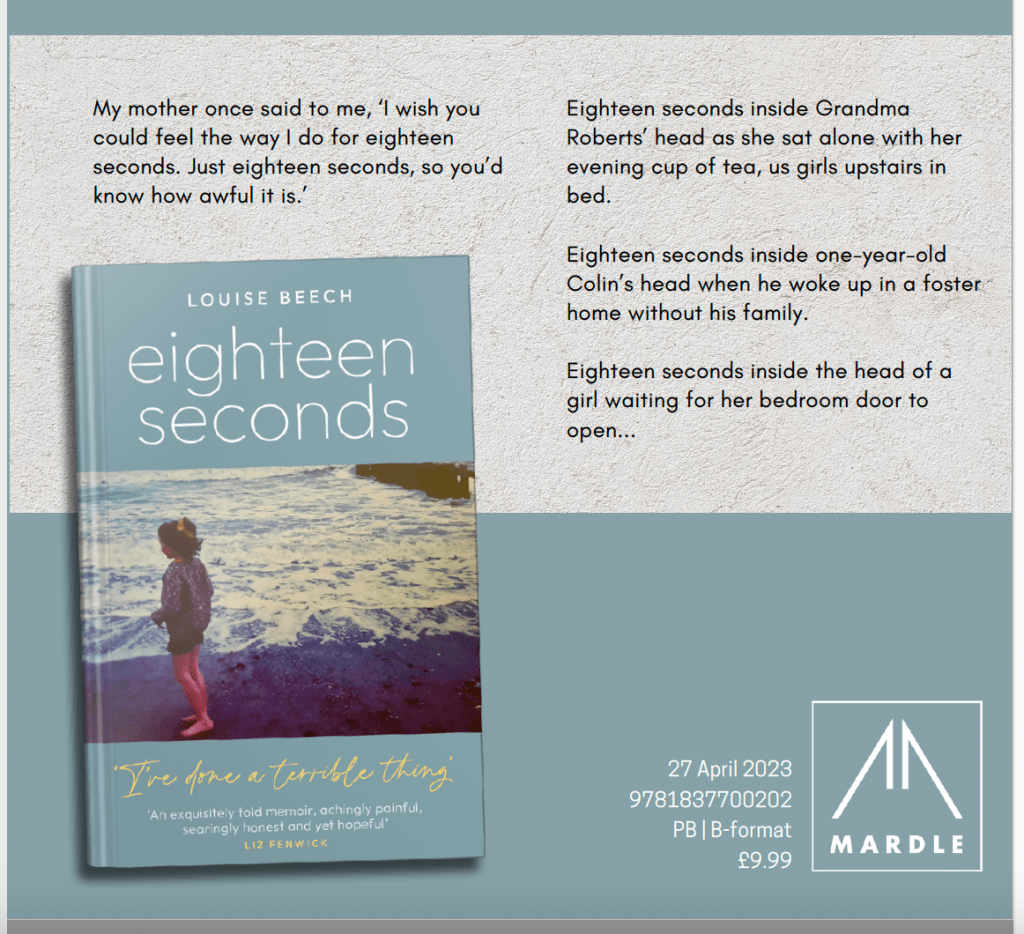
One of the most challenging – but ultimately rewarding – books I’ve written in my now ten-year career as an author is my memoir, Eighteen Seconds. It began in the wake of my mother’s shocking bridge jump, at a time when her recovery meant my life was on hold. It was the story that choked me when I woke too early, kept me sleepless at night, and impacted me (and my poor family) physically, mentally and emotionally because it shot me right back to a painful childhood. The only way to push through was to write it. It was how I’d always coped. The words. The page. At first, as the usual drive took hold, I wrote it for myself. As therapy. My family contributed their thoughts, read the chapters as I went, offered suggestions and opinions. Then, it went to my beta readers. And many of them suggested this story should go further. I should share it with other readers. A publisher. The world. It could help so many, they said. Inspire conversation about survival and trauma. So, I did.
In the book I explore a life shaped by my painful childhood. I decided to be brutally honest about my flaws, about my promiscuity as a young woman following childhood sexual abuse. About my eating disorders and insecurity and difficulty trusting men. A memoir of this kind must never shy away from the truth, from the fact that I have emerged from trauma marked, with many imperfections and curious coping mechanisms; don’t get me started on not being able to go to bed and leave the sofa cushions in a haphazard manner. But trauma, while being a reason, is never ever an excuse to hurt others. I’ve recently read a variety of blogs and articles where cPTSD sufferers have blamed this condition for their abuse of others, for their illegal behaviours, for their lies. This shocked me to my core and had me down a rabbit hole of cases where trauma is used to avoid taking responsibilty. This brilliant piece in #PsychologyToday explores the idea: Trauma is Not an Excuse.
There’s a big difference between blame and explanation. Being diagnosed with cPTSD is never a free pass to hurt others, or an excuse to indulge in illegal or violent behaviours. In the link I shared above, Katherine Cullen describes how trauma is any experience that overwhelms our ability to cope and undermines our sense of safety. It can rob us of the belief in our ability to heal, trust, live, and love as we did before the traumatic experience occurred. However, it’s not an excuse for perpetuating harm, nor a get-out-of-jail-free card for causing pain to others. She gives great examples of such cases. A woman who tries to shirk blame for cheating on her partner because she was sexually assaulted in college, says this causes her inability to get close to one person. A man who argues he can’t be held responsible for manipulating women because childhood abuse has trained him to treat women in such a manner. A person caught in a web of lies tries who distracts from the harm their deception causes by portraying themselves as broken by trauma and therefore innocently unable to predict the negative outcomes of their lies.
If my experience of trauma/cPTSD causes me to steal the drugs I need for my habit, or to dominate, control and abuse my husband emotionally/mentally, or to compulsively cheat and lie, or to neglect my children, then that is on ME, and I’m no better than the abuser who initially caused me such pain. The cycle goes on. I am them. Indugling in such behaviours is on us as a person, not on the experience we had. According to Katherine Cullen, the prevalence of violence in those diagnosed with PTSD is about 5 to 12% which suggests to me that (thankfully) most of us who experience indescribable difficulty do not hurt others. And so is it about character? Do this small number of people who continue abuse suffer with something other than PTSD? Narcissistic personality disorder perhaps? But that deserves a whole piece of its own. Whatever the case, it should be about accountability, attempting to heal (I’m well aware that this is a LOT easier said than done), putting right what may have been wrong, and compassion for not only others, but for ourselves and for our many flaws.
It’s been a while since my memoir was released. It’s been a while since I wrote anything here. It’s been a while since I assessed life beyond the release of my autobiography. It’s been a while. So here I am. What has happened since I decided to share my life story? I’ll come to that. It was a decision I didn’t take lightly, deciding to hand my words over to the world. I wanted to be honest, flaws and all. But I didn’t want to hurt anyone. This was why I invited my family to read the chapters as I went, and gave them the space to share their own thoughts and experiences. I then included those paragraphs on my pages. I also resepctfully decided not to include things one family member requested were omitted. It’s sad to read certain parts now because one of those ‘voices’ passed away at Christmas.
My lovely memoirIn the spot were I saw those daffodils…
Uncle Edwin (also known as Uncle Lapwin, which I apparently called him as a child because I couldn’t say, yes his very simple name!) died suddenly on Christmas Day, UK time. Those who’ve read the book have commented on what a powerful figure he was in the story. He was. And though he lived in Tasmania, I felt he was close at times, in the voice notes and messages he sent me, always concluding with a joke. He was a massive support when our mother jumped off the Humber Bridge (the core of the memoir) and again more recently when Joe and I needed it. In his last voice note he joked that the doctor had told him he had fourteen years left. ‘That’s a very precise prediction,’ he said. ‘No, it’s an average, since you’re seventy-four,’ said the doctor. ‘I’d better get on with everything then,’ said Edwin. He planned to go to Nepal, maybe another visit to England, more theatre. He died just three days later. Live your lives, folks, Do it now. I miss you, Lapwin.
Lapwin interviewing me at my launchAlways telling a funny tale…
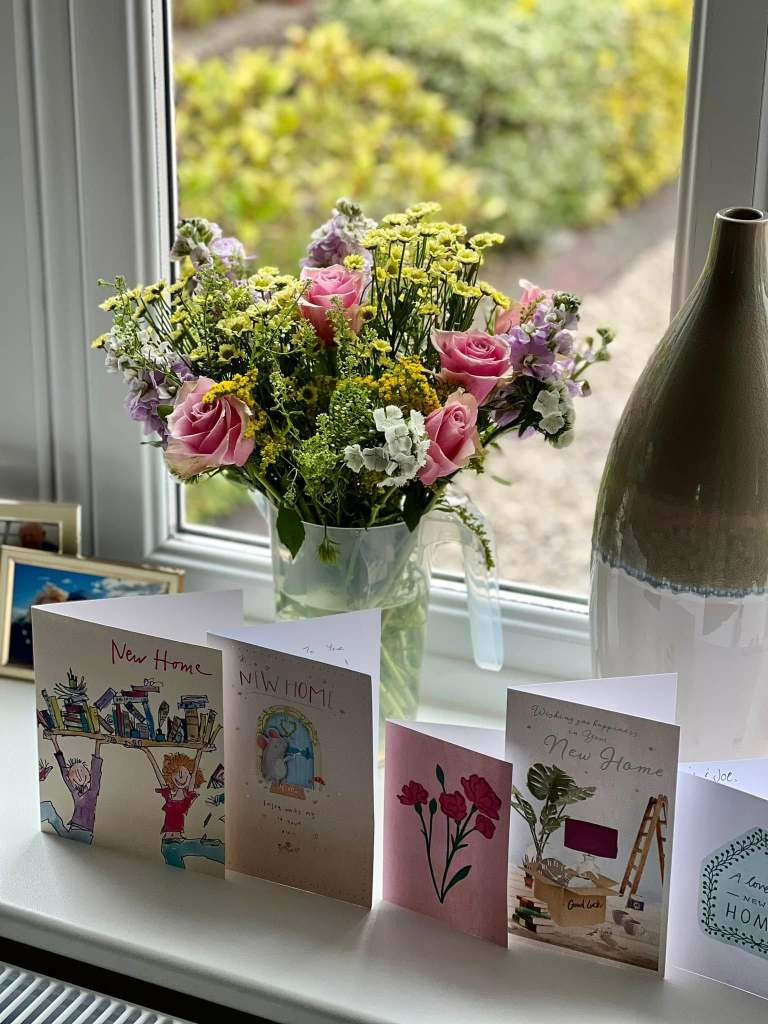
What, then, has happened since Eighteen Seconds (Daffodils in audiobook) came out? I left the town where I lived most of my life. Where most of what happened in the memoir took place. Too many ghosts. Too much pain. New pain and old. Open, fresh wounds, and closed. I was ready for the future, for new things, and after saving hard for many years Joe and I bought our dream house in a village near the Wolds. I have my first writing room too! There have also been other forms of closure. My dear sister Claire, who loves doing historical/ancestral research, discovered what happened to the childhood abuser I mentioned (but obviously didn’t name) in my book. It came a week after I left my old house, and it felt like the universe was saying, yes, Louise, it’s time to move on, heal, and grow. All I’ll say is, he likely didn’t hurt anyone else. And this is good. So how are things now? Last year was extremely testing. I hoped after the memoir (and I often said it at events) that that was it for drama. But sadly, my pain – and far worse, my family’s suffering – wasn’t over. It is now though. That’s all I will say. My life now is about the good people, and there are so so many of them.
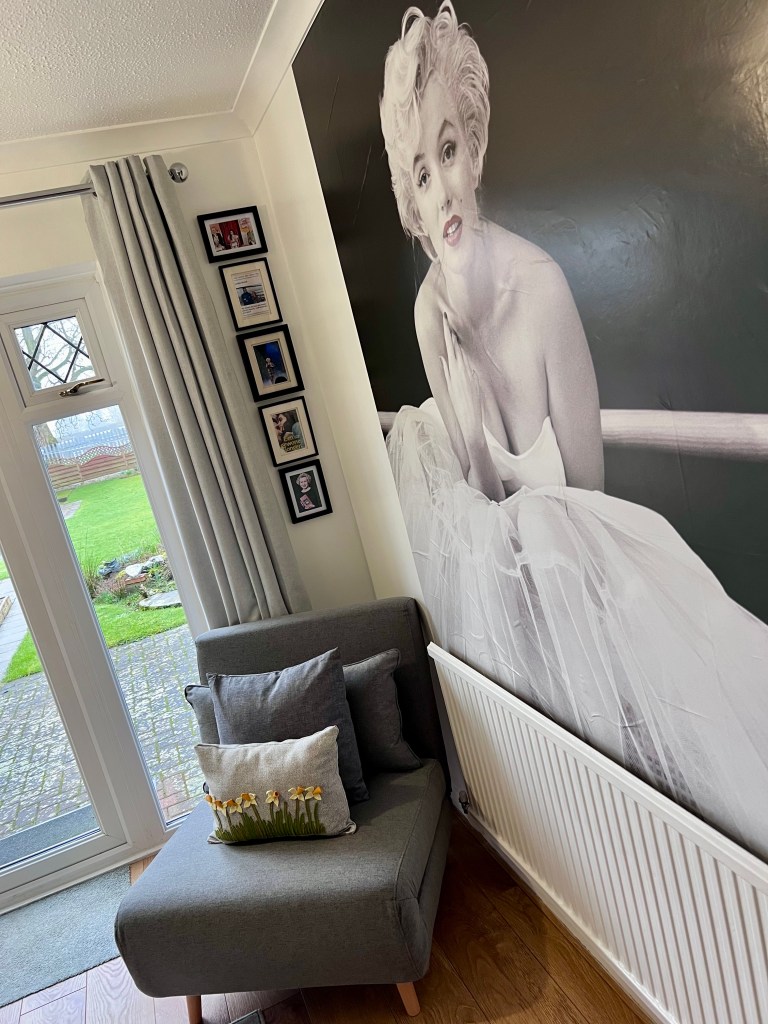
A quiet corner of my lovely new office…Our new homeAnd a garden that brings me great joy…
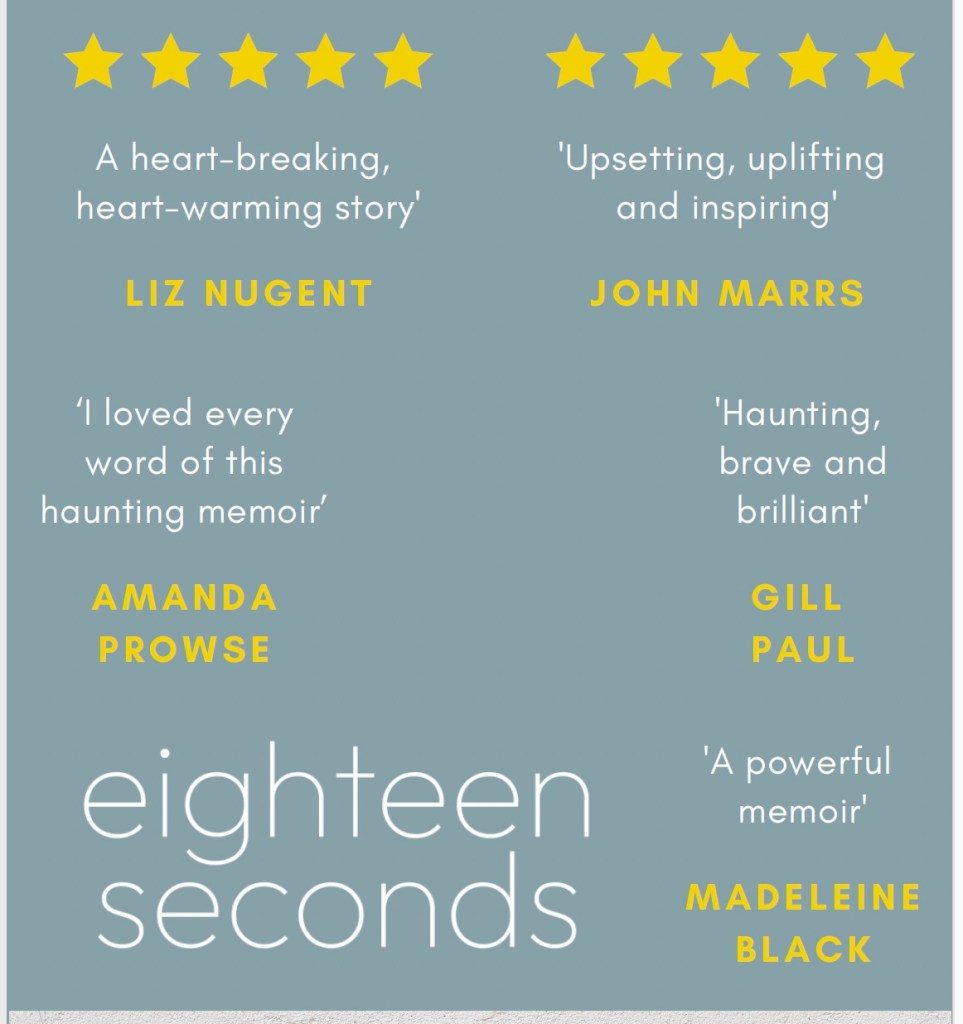
So why did I decide to hand those words over to the world, as I described it earlier? Aside from the theraputic aspect, I sensed (and my instinct rarely lets me down) that writing my memoir might help other people. There are a few taboos in the book, mainly a difficult mother that results in me ending that relationship. It also explores coping with narcissistic abuse, along with childhood trauma, the resulting cPTSD, and my mum’s violent suicide attempt, but all with a topping of very very dark humour. I wasn’t wrong. About it reaching others. I’ve had hundreds of messages since the book was released. Some have simply been readers with kind words. But often these contacts were women who ‘felt seen’, as the saying goes. Many opened up to me about their own experiences, and thanked me for sharing things they’d been through too. Things ‘no one talks about’. That’s the power of our stories. They validate. Our openness with them invites others to share. Thank you to everyone who has read and responded to Eighteen Seconds. Your words have helped me a great deal – and I hope that helps you in return.
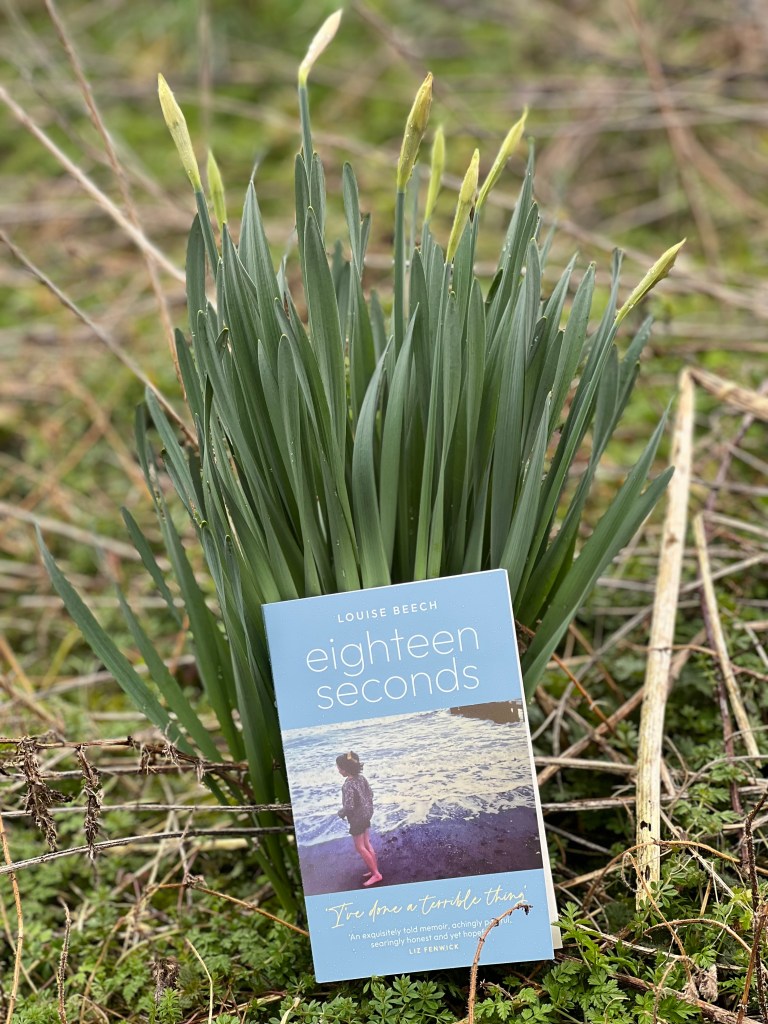
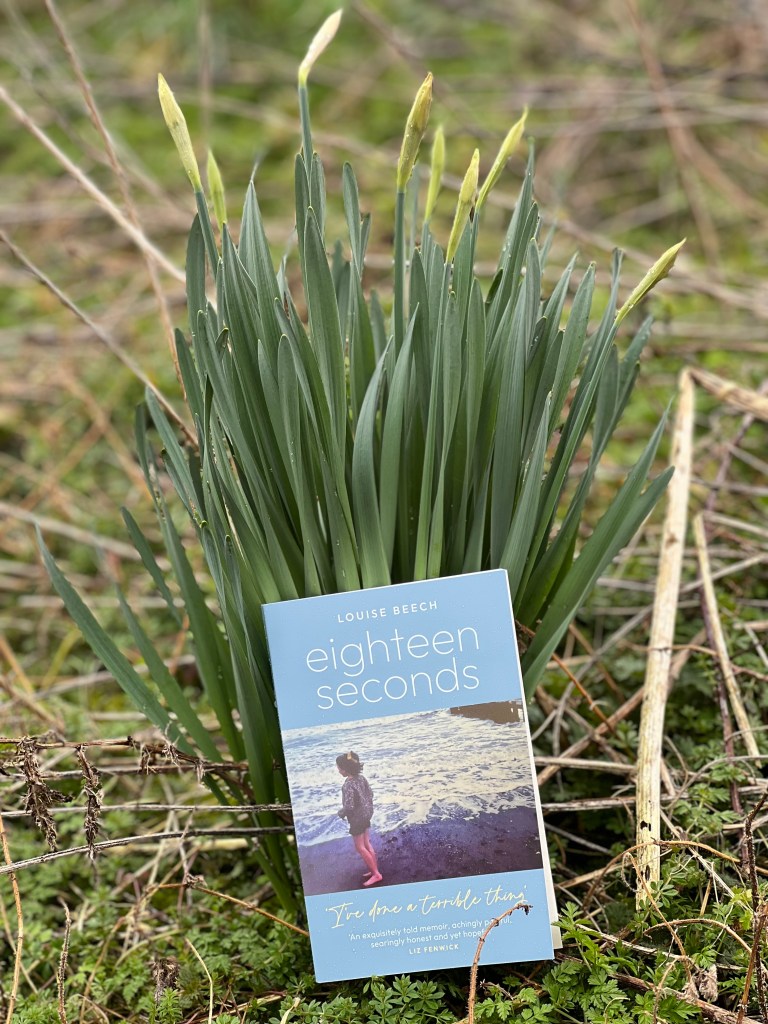
With the daffodils beginning to emerge (flowerless for now) from the ground, would I write another memoir? This is often asked of me at events or online. Because there is no THE END with our own stories. Life goes on. Good or bad. At present, no, I wouldn’t. But of course my real life will worm its way into the novels and maybe plays, as it often does. Look for me there. Look for my truth in that fiction. Because no matter what, I’ll always be honest with you.
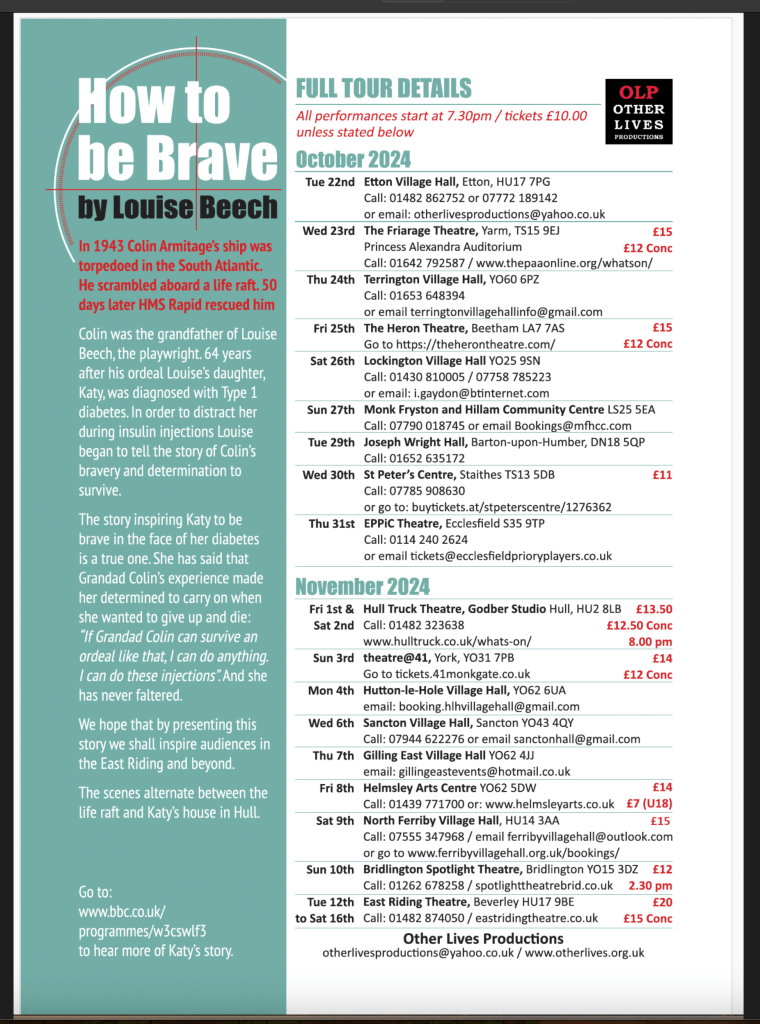
Here are all the dates and venues where you can see How to be Brave when it tours from 22nd October until 16th November. I hope to go to a few performances and would love to see you there. If you enjoyed the book (or if you didn’t yet, do look it up) then you will – hopefully – love the play.
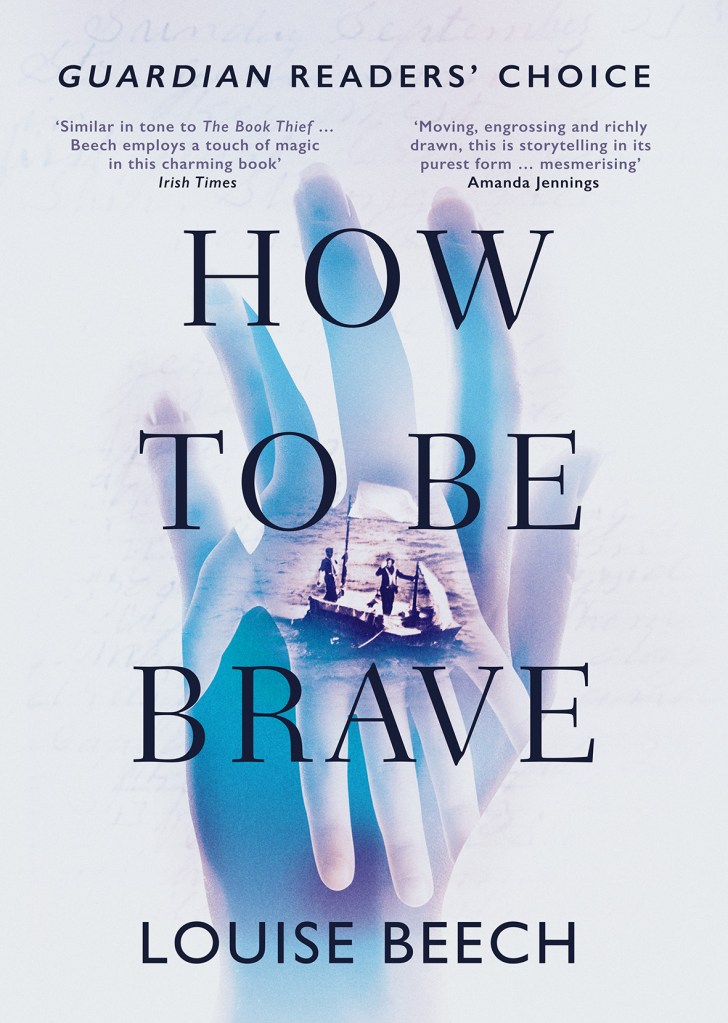
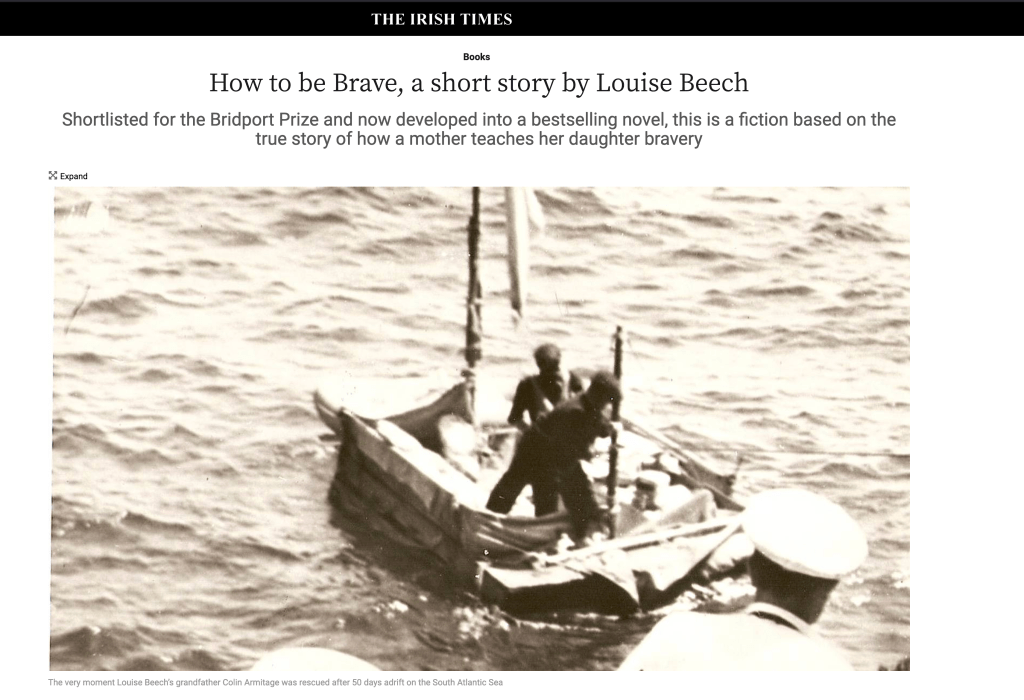
My debut novel, How to be Brave, was released nine years ago in September. How on earth can that be? NINE YEARS. Since then it has hit Number 4 on the overall Amazon chart, been a Guardian Readers’ Pick, and been called a ‘gentle book, full of emotion, suitable for young readers, and similar in tone to The Book Thief, a book that Rose reads with a torch under the bedclothes’ by the Irish Times.
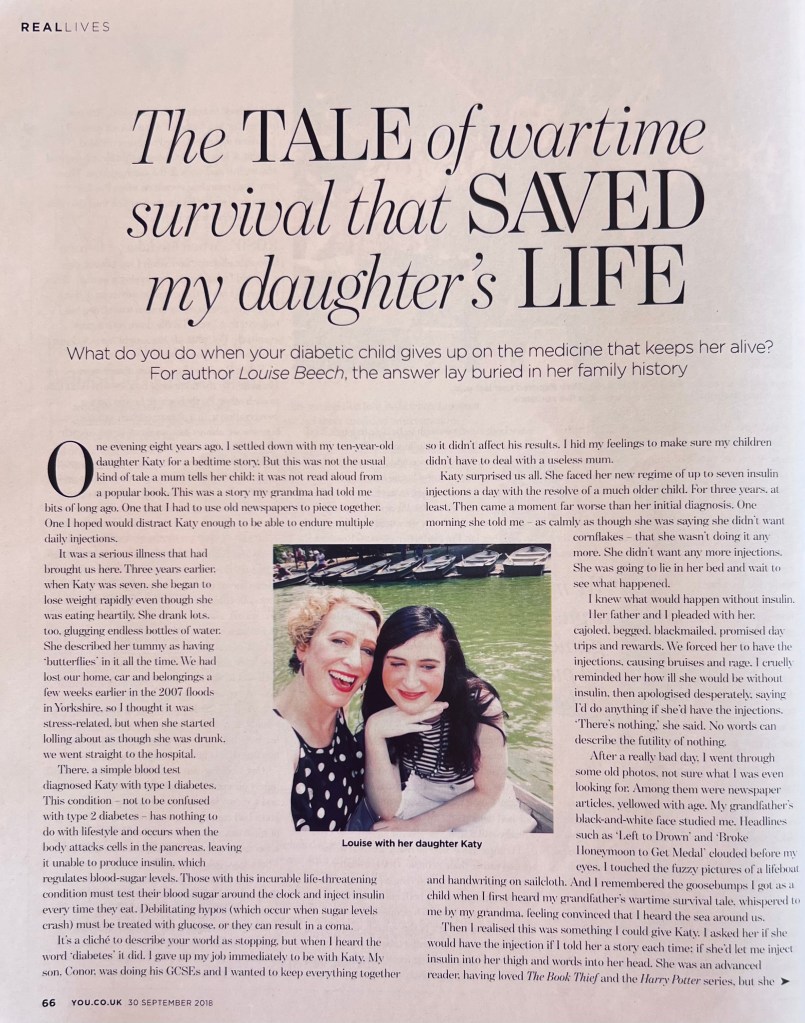
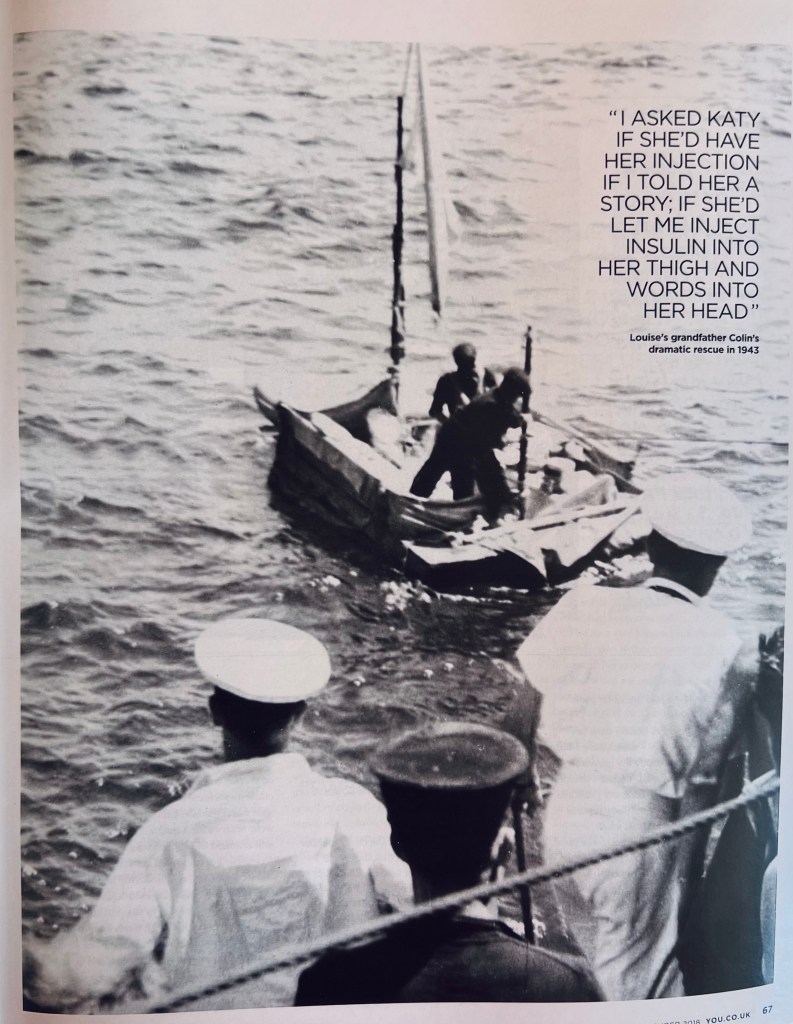
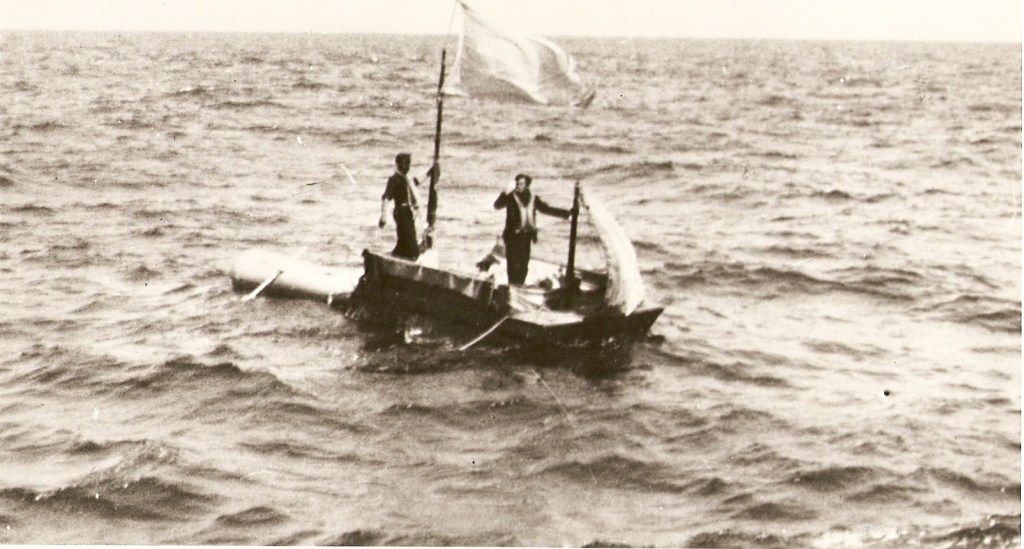
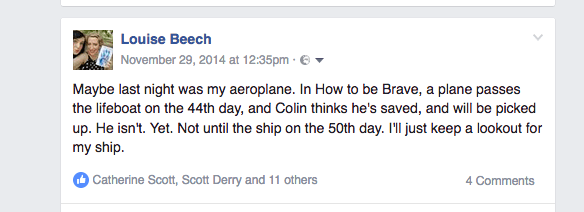
But that special day in September 2015 when it was published wasn’t the start, not by any stretch. And it isn’t the end. Because the book that was inspired by two real-life stories has been explored in other formats – as a short story, also published by the Irish Times, and as a play, which will be staged later this year. The tale of my daughter’s Type 1 Diabetes diagnosis aged seven, and the difficulties we encountered, began as a short story in 2010. Back then, to help Katy cope with injections, I had begun sharing the true tale of Grandad Colin (Armitage)’s wartime sea survival aboard a cramped lifeboat in the middle of the South Atlantic Sea. When the merchant seaman’s ship sank he and thirteen other men made it to the vessel, and survived on tiny amounts of water in unbearable heat. By day fifty – when they were finally rescued – just two men remained; Colin and the ship’s carpenter, Ken.
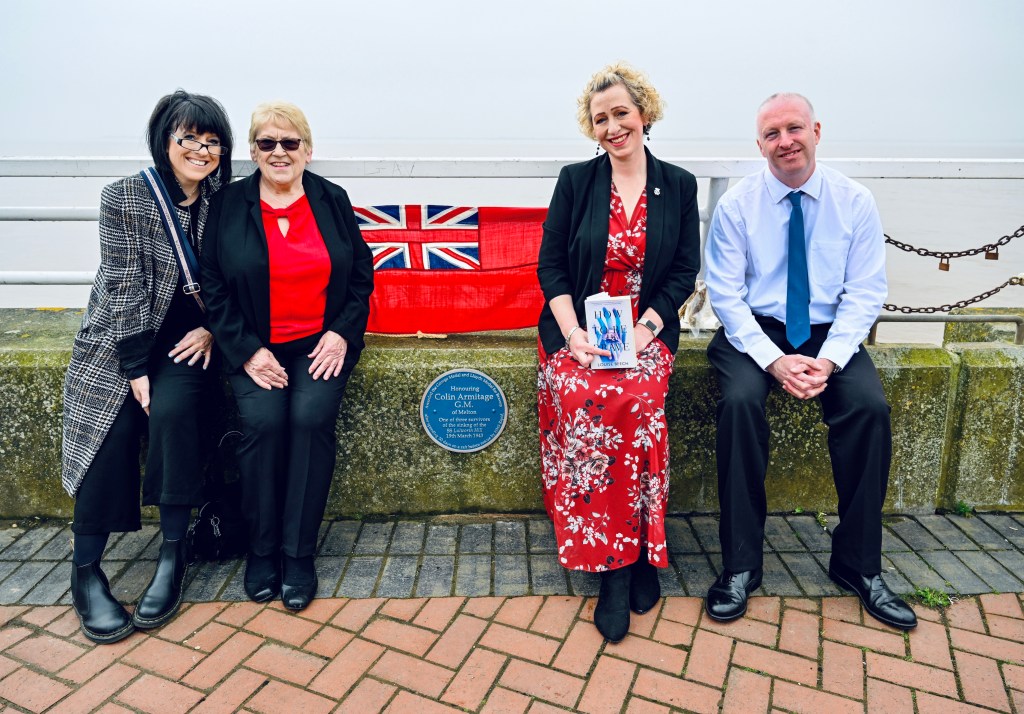
Colin’s bravery helped Katy. It helped me too. Often has since. And I knew there was a bigger story here. One others might find inspirational. I scribbled words down in a notepad. A short story formed. It shortlisted for the Bridport Prize in 2011. This urged me on. I developed the story into a play. No one was interested in it though. So, I wrote the novel in 2013. And the rest, as they say, is history… In the real world, since the book was published, there have been many developments. I’ve met other relatives of the brave men who were aboard that lifeboat. We finally located Colin’s grave in North Ferriby, East Yorkshire, and a ceremony was held there in his honour in 2017. And last year, on the 80th anniversary of his rescue, a blue plaque in memory of Colin Armitage was unveiled on Hull Marina.
And now, at last, the play will come to the stage. It hasn’t quite sunk in. My grandad’s story will be shared yet again, in another form. On 22nd October Other Lives Productions will take it on a 22-date tour of North and East Yorkshire, including shows in York, Yarm and Bridlington, and concluding with two nights at Hull Truck Theatre and a week at the East Riding Theatre, Beverley. I’m sure this is going to be quite the experience, watching it take shape and witnessing rehearsals. There are going to be so many emotions, not just for me, but for the entire family. As soon as I have more details, I’ll share them, and hopefully I will see you at one of the shows.
Neil and Richard from Other Lives Productions had this to say about the play: ‘Our problem is that with a cast of five and a two-location set (a life raft and an interior) we are short of what we need in order to stage and tour the production. We are appealing by suggesting that donors might like to subscribe as what is known in theatre terms as an ‘angel’. That is, you subscribe money on the basis that it maybe no more than a donation, that if the show ends up in profit you get a proportion back, and may indeed receive back more than you subscribe, if it does really well. At the very least, we shall offer complimentary tickets to a performance.’ Other Lives Productions can be contacted at Toad Hall, 70 Lairgate, Beverley, HU17 8EU. Call 01482 862752 or 07772 189142.
Before the novel, there was the short story. And then a script – more on that next year when it comes to an East Yorkshire stage. Want to read how it was back then, when my daughter’s name was still used instead of Rose? Here you are…
We trade blood for words. This is our currency; her pain for my prose.
I don’t recall who thought of it but I’d like to give Katy credit. I’d like to say she spoke the suggestion through a spoonful of beef casserole, between school stories and Top Gear. Or maybe she grew tired of my terrible singing. A few verses of Phantom of the Opera I mumbled to distract when pen’s tip pierced skin. Stifled laughter from my daughter. Laughter causes hurt. Trembling flesh resists needle. Resisted needle bites harder. She suffered more.
Now, no singing. Now I will talk words.
I asked when we agreed the swap, what if I run out of ideas?
You’ll never run out, Katy said.
Such faith. Easy for one to say who isn’t thinking them up.
You could sing Rihanna instead, she said.
I knew she was freeing me from obligation as she couldn’t be freed from hers, letting me badly sing pre-written lyrics instead of working for my words while she endured finger prick after pierced thigh after finger prick after pierced arm after finger prick after pierced stomach. Are my put-together-on-the-spot words a fair rate of exchange? This I ask of myself. This I privately wonder when she puts damp head to my shoulder, a place she now easily reaches, and her hair tickles my cheek like shampooed spiders and her forehead smells of gravy and she cries as though she isn’t, as though I’m not here, as though I lived many years ago and never met her at all and only whispered across the South Atlantic sea.
On the raft they told stories to pass time. They probably didn’t care if these were fantasies or histories. Do lies bounce best on ocean waves; does pretence give comfort? In the dark we are all the same; no one is more hungry or happy or needy or worthy or injured than the next person. So at night, when lack of moon equalised them, fourteen men shuffled for the best spot in a space designed for half their number and talked until sleep washed whispers away. Talk of home hurt most. Lips cracked and bleeding could not easily voice the existence of that other place beyond a makeshift lifeboat, measuring twelve feet by eight. Soon talk faded. Poetry died. At the end, after fifty nights, two men remained. Two stories. Two, like Katy and me with our box of lancets and insulin, ready to draw blood, to cut, to read and record numbers in a log like that kept at sea. Can stories last seven weeks with one biscuit and four Horlick’s milk tablets and six ounces of water daily? Do they continue over the horizon? I hope so. We make it so. But this is not the story I will tell Katy. No. Not yet.
So let’s start gently. Gentle verses for blood.
Tell me a story about you, says Katy.
She puts the strip in the blood-reading metre with slender red-tipped fingers. I kissed those hands at birth and willed them to be kind, to be gifted, to be brave. To hold mine, her father’s, her brother’s, to hold a pen or guitar or paint brush. Now we cut their tips twice a day.
The story, demands Katy. You’re supposed to be distracting me.
I’m meant to make them up, this was our agreement, but she wants truth now, to know about me and about her and about anyone else who matters.
Let’s start here then; when I was three I almost drowned. I have opened crudely. It’s too late to retract my vulgar hook; huge eyes express interest. While on holiday in Wales I fell in a stream. My mother and father picnicked at the other side of a field and didn’t see. Finger pricked, blood flows. I’m a hopeless storyteller, summarising, giving no background, few specifics. But Katy hasn’t noticed her pain. She asks how I got out of the water (I’m unsure, it was all a blur) and why I got into trouble (because I ruined my new yellow jumper) and what happened next (we had beans on toast for tea). Answers dampen insulin injection’s sting. They last until liquid finishes its fiery course through her body. They follow us until next time, like only the best end-of-episode cliffhanger.
Let me share an amusing story about you and some water.
I’ve got three bruises on my thighs and two on my arms and four on my stomach, Katy says, angry.
This tale hopes to smooth over bumps and ease the constant cycle of changing injection site to cause least damage.
I hurt, she snaps.
Anger is easier than sadness. Anger fights and so submits too.
When you were two you wouldn’t go in the bath.
Well, the bath is a dangerous place, she says.
Her blood glistens thick and warm. You’d only get in if I promised stories and you wore a striped swimming costume and could stand up, like a statue. Imagine trying to wash unruly hair that way? Trying to dry skin over a damp cozzie?
A blood reading of two-point-eight means a glass of coke and dinner before injection. Injection means another story. I talk about the red and green blow-up pool she wee-ed in and the time she ate spaghetti bolognese out of the bin because she was still hungry. Bruises are curious, appearing long after pinprick, staining fleshy expanse like driftwood at sea. So we do not yet know the cost of today’s cut.
I’d like a big story, says Katy now. Not silly short ones. Something I can look forward to each day. Not random. Chapters. Long and detailed and wonderful. And true.
I know such a story.
It started off the coast of Africa, not far from Ascension Island, named so for its discovery on Ascension Day, which celebrates Jesus’ rise forty days after the resurrection.
Ascension, ascension, says Katy. No bible stuff. We do enough at school. It’s rather relevant and poetic in light of the imminent story, but she doesn’t yet know how. So, this story began 19th March 1943 when a ship carrying my grandfather, Colin, was torpedoed by Germans and sank in one and a half minutes while most on board slept.
I began in March too, says Katy.
She cuts her finger and we read the blood – four-point-nine. Blackened by fuel spillage and wearing explosion-torn clothes, fourteen crewmen managed to climb aboard a vessel formed by tying together two life rafts. While the SS Lulworth Hill split in two when she sank, each part likely landing in the seabed miles from the other, salvation required coming together. Katy measures insulin and pumps it into her thigh while I read the roll call of men – like the school register, says Katy – and I describe injuries like broken ribs and feet.
Colin was my great grandfather then, she says.
Yes. Yes, he was. He is. Let us end there for now.
Briefly, before words worked magic, Katy joked that money might lessen her pain. Extra pocket money for her bravery. A quid for each injection. But we are prehistoric; as those before the invention of money traded things, so do we. Such transactions have taken place throughout recorded human history. There’s evidence that obsidian and flint were exchanged during the Stone Age and sea trading routes appeared in the third millennium BC.
What about the men on the boat? asks Katy, already having read her blood, just the anticipation of more story enough to make it endurable.
Okay; the SS Lulworth was a cargo ship. Once all who had escaped her were safely on the raft, sunburnt and salty, First Officer Scown assessed that they fringed a shipping lane but were drifting fast. A trade route meant hope.
What about Colin? asks Katy. I bet he was most hopeful they’d make it home. The first log’s entry, a book that would record twelve deaths, ended with: Expect rescue any time now.
How soon will it come? asks Katy.
Oh, not yet. Many blood tests and injections later. Did they have any clue when? That first night they calculated thirty days travel to the Liberian border – 800 miles from land – and ate no food, knowing they should save what little they had for a long time.
But Katy must eat now. She must eat a meal rich in starch and fibre, now and later and tomorrow, or she will not last fifty days.
Days that follow routine merge like mudslides. A logbook listing numbers, dates and liquid measurements is the dullest of diaries. So we make it interesting. I drop syllables in the endless ocean.
There can’t have been much to look at, says Katy. If they got tired of the sea, the sky wouldn’t have changed much.
The fourteen men must have looked at one another. I set up the blood meter. They must have watched their companions disintegrate and, without mirrors, wondered at their own state. Prick, pain, blood reads eight-point-eight. On the eighth day they woke with tongues fat in their mouths, like black cotton wool. Saltwater boils stung so much it hurt to move. Headaches throbbed from blistering sun and lack of water, tempers frayed easily.
How old were they? asks Katy.
Five men were younger than twenty, and many were not even seamen, coming from farms or factories. Colin was twenty-one. I imagine he felt responsible, having rescued ship-mate Ken from the water when the ship sank, others too. In saving them was he obliged to continue so? You look after me. Six bubbles spoil the smooth span of insulin, like barnacles beneath a boat. Six men at a time could shelter under canvas awning; eight remained in the sun. Food held no appeal with such thirst. Some drank seawater in desperation.
Where’s the harm in that? asks Katy.
Excess salt makes you urinate more than the water gained from drinking it, increasing dehydration.
Like sugar in my blood making me wee so much. How thirsty I was then. Would they have felt like that?
Yes, like that. So softly, yes, like that.
Tell me something happy.
When night fell on the eighth day it began to rain. Desperately they opened mouths like petals to the sun, but it stopped almost as soon as it had begun. Two younger men sobbed. Hungrily, they licked the thin film of moisture off the canvas. I’m sad, says Katy.
But her injection doesn’t hurt.
Is this story too much? Should I return to cheery childhood tales of paddling pools and crazy baths? No. Katy brings her box of needles, eager. She wanted another chapter between pinpricks, promising she could endure pain without words if the tale ended sooner. Let’s wait, I said. Let’s remain true to our trade.
Someone must have died, says Katy, cross-legged as she often sat for bedtime stories once upon a time.
The first death occurred after nineteen days of watching the waves for ship or land, searching one another’s faces for life. First Officer Scown died, having removed his ring to be passed on to his wife. Many more deaths come. Men jump overboard to be eaten by sharks. Some drink seawater until madness takes them, begging for water as they go. Shall I tell Katy these things? Should I assess her bravery each day? Is it fair to exchange pain for pain?
So how long would I live on a raft like that? she asks, eating a sweet, jammy biscuit to prevent further hypo.
There are many answers; in as few as twenty-four hours diabetic ketoacidosis would occur without insulin, and vomiting, dehydration, deep gasping breath, confusion and coma would result. It might take days, even weeks, with so little to eat. But a lack of water would be most dangerous. I will not sing these lines though. It’s time to put the box away and watch some TV.
You’re a coward.
I suppose I am.
I’m sorry, I’m sorry; you’re not cowardly at all.
I suppose I’m not.
Animals have featured in written literature for thousands of years. Bible stories had animals signify various human and godly traits, like the snake, the swine, and the lamb. Superstition has it that while sharks follow a vessel where death will soon visit, dolphins lead such a boat to safety. Rain hits the patio doors as though to break through. Katy covers her ears. I need her fingers, take them in my hands. She resists. A dolphin saved them for a while. Katy submits. They harpooned one on the twentieth day and ate its flesh and blubber, and drained all blood into a tin cup and drank of it.
Poor dolphin, whispers Katy.
Perhaps he surrendered too. It isn’t easy to catch one. And Ken, who managed it, was weak. Must the dolphin have swum close enough to be caught? What about the sharks? They’re mean and would make a better tea.
Ah, the men wished to catch such a beast. Sharks were a constant threat, swimming often on all sides, waiting. They named a large brute Scarface, because a ragged slash scored his head. Scarface swam with them until the end.
Can we say goodnight now, says Katy. Let the poor men sleep. Would they sleep? Would they dream?
Each day they watched the sun set, desperate for escape from its heat. By morning, after coldness and nothing but hard surface to rest on, they longed again for its warmth.
Tell me about Colin. Just him. Did you know him?
No, we never met. He passed before I existed.
You seem to know him like you know me or dad or Conor.
I think memories are part of our make-up, passed on genetically, reliving somehow in our DNA. I’ve only read about him but I smelt his presence between black printed paragraphs. Like blood, blood that flows now onto a strip. Blood we read as three-point-five. By the thirty-fifth day just two men remained – Colin and Kenneth. The story is theirs now. On the twenty-ninth day, unknown to them, a letter got sent from the owners of the Lulworth Hill to family members, advising that all onboard were likely dead. The thirtieth day was when their First officer, now gone, had predicted they’d reach the Liberian border. Instead it was a horrible day. No land. No ship. No rescue. Three men jumped into the sea and were eaten by sharks. No one tried to save them. No one had the strength. So came day thirty-five, and Colin and Ken clasped hands in their grief. Katy sucks her finger. Blood is sweet. Salt is sour. And so the raft drifted on an unchanging sea and two men lapsed in and out of coma and rain never fell and Katy doesn’t cover her ears.
Some days blood won’t flow, no matter how we pierce skin. Today is such a time. My Little Pin Cushion bears it well. She does not cry. But I do.
Let me distract you, mum, says Katy.
But I’m the storyteller.
I didn’t bring blood today, so let me do the words. It’s only fair. Listen to this – I went on the raft last night. Snuggling between the two sleepy men I stroked Great Grandad Colin’s hair and whispered right in his ear how proud I am of him. I did. I knew which one he was. He smelt right. Even though he looked like a scarecrow, all hairy and ragged, he still looked like us. I said I’d tell him a story to distract from his nightmares and the wooden floor. It really was uncomfortable, Mum. Not even a sheet. I said I bet he missed spider webs in rain. And butterflies. And birds. He used to go bird-spotting with his dad. There a bird means land and safety. I said, if you don’t live I’ll disappear, Grandad. I won’t be able to come back and stroke your hair. I’ll just dissolve like a salty ghost. So I ripped a page out of the logbook and drew us all in there; you and me and Conor and dad. I wrote above that you have to know how to be happy to know how to be sad, and if you know both of those things you’ll know how to be brave. He woke up after I’d gone and found the page and thought he was going crazy. He was sure he’d written the words because the handwriting was a bit like his. But my picture made him smile. He woke Ken and they had their tiny portion of water and horrid dry biscuit and milk tablet and they looked out at the sea for sharks and dolphins and birds. It’s okay to be sad, mum. It means you’re brave. We’ll have to just guess my number today. You always get it right. You always know. What do you think?
I think we’ll have ice-cream after tea – a really big portion.
Remember the first Christmas after you’d been diagnosed? Remember how I replaced sugar with a substitute in cakes, used horrible diabetic chocolate bars, trying to make everything the same as Christmases before.
I remember.
It only highlighted that this one was different. But today is not Christmas. It’s a day like any other. Katy bleeds; insulin resuscitates. It’s hard to make stories out of such sameness. Suffering has a sameness too.
I’ve loved the boat story, says Katy. I know it’s going to end soon and I so don’t want it to, but I guess we’ll talk about the scratchy carpet in my first bedroom and the yellow bunny wallpaper in case I turned out to be a boy.
Her memory surprises me as much as the prediction that I’ll soon recall it during our trade. But let’s talk now about rescue. What do you think signalled it?
A dream?
Perhaps.
No, a bird.
Yes. Seagulls. On the forty-second day a group of them circled the raft, birds that rarely venture far from land. In the log Ken wrote, many birds around, can’t stand up now, we will stick it to the end. Katy’s blood reads eighteen-point-one. High. Could be excitement or illness or too much food or too little insulin. High in the sky, on the forty-third day, they spotted a plane. Colin set off a smoke-float, filling the air with dense red vapours. Had they been seen? More hours passed, hours longer than the days preceding. Hope dwindled with supplies. On the forty-fifth day another flew over and dropped packages, like gifts from Santa’s sleigh. A gas cylinder and a dinghy and a rocket pistol and a kite, but like the Christmas when we endured sugar substitute and craved sweetness, they only wanted water. Eventually it came. Day forty-eight brought tins of water from the sky, and cigarettes and barley sugar and real chocolate.
Excited, Katy says, I know how they felt. When I’m low and eat it feels like someone injected me with happiness.
Let us end, for now, on that high.
The best stories end openly.
No, neatly, insists Katy. All tidy with everything sorted out.
Her injection box is almost empty; our dwindling supplies are easily replaced, ordered from the doctor. I shall try and give her the ending she wants. Scarface knew an end loomed. On the fiftieth day he charged at the raft, perhaps sensing the men were hours from death, perhaps smelling a day of rescue. Neither had strength to fight, and the faithful shark gave up when the heavy raft wouldn’t relinquish its cargo. Colin spotted a ship, just as he had seen Ken in the water fifty days earlier. A ship, a ship, a ship, a ship. They said the words over.
A ship, whispers Katy.
Neither remembered much of those first days on the HMS Rapid. Fed warm milk regularly from a baby’s bottle, they slept in beds deliciously comfortable. Then, in Freetown they recuperated at the Disabled British Seamen’s Rest. Here Colin was said to ahev suffered his first epileptic fit. What’s one of those? asks Katy. Her injection is done without complaint. Story time is over. But we cannot leave such a question alone. Epilepsy is a neurological condition where the sufferer has seizures that start in the brain. Many things cause it, from genetics to injury of the brain. Triggers like stress or tiredness can bring on a fit. Let’s save one more chapter now.
We’re almost there.
Like the SS Lulworth Hill’s two halves pulled by currents to land far away from each other, Ken and Colin separated. Once home, once medals had been received for bravery, once children came, life resumed and they untied the ropes and cast adrift.
But why? Surely they’d be friends forever now?
Doctors asked Ken to stay away from Colin, thinking his presence reminded of their ordeal and brought on the many violent seizures. Colin never knew of these orders and died, years after, thinking his friend had abandoned him.
No, whispers Katy. He’ll know now. He must know now.
We have not yet read her blood. Our exchange is off balance. I’ve given lines too easily and now there are none left to dampen her pain. She winces at the cut but nods to show she’s fine. Time doesn’t heal. Time lets wounds fester and blister in hot sun, it bruises legs and arms and tummy with pinpricks. Really, time separates.
Are these your words? They sound too not you, Mum.
Maybe they’re mine, maybe they’re his, maybe they’re yours. I’m not sure. But I think the dark heals. Don’t you? So do stories. Here we’re all equal. All characters have a part to play. So what now? Colin is home. He’s in whatever place we go when we’ve earned a rest.
You’ll have to sing again now, says Katy. Sing Music of the Night. Or that Lady Gaga one with the German bit. Or just tell me about when Dad was little and did a karate chop through the kitchen wall.
A competition should always be a level playing field. Each entrant should have an equal chance to succeed, follow the same rules as everyone else, be treated fairly. Otherise, it’s not a competition, it’s pretending to be. Sadly, in the book world, it isn’t always so fair where prizes and awards are concerned. Because some books don’t have an equal chance of being entered into certain competitions in the first place. The rules may be equal once you’re in, your book may be judged on its merit once you’re in, you may have a chance once you’re in. But you can’t get in. Here’s why.
The brilliant indie publisher of my memoir, Eighteen Seconds, considered entering it in a certain non-fiction prize. Obviously, I was excited. Then they saw the T&Cs. At various stages of the comeptition, large amounts of money are required form the publisher for ‘promotional activity’. And they simply don’t have it. I understand that prizes have to find money from somewhere for funding and costs, that these things can’t be operated without such donations, but this immediately alienates small/indie publishers who don’t have a vast budget. And that means that only certain books stand a chance. Even with bigger publishers who can fund such competitions, they will have to choose a ‘sure winner’ as the book they find they money for – and ‘sure winners’ are often very big names.
I don’t want special treatment. I don’t think my book deserves to shortlist, longlist or win over any others. But this experience made me think of the many books published by smaller presses that deserve a chance to be considered in the first instance. I’ve read some breathtakingly beautiful books from indies. Many of my favourites on my bookshelves were released by such publishers. And as I’ve savoured those literary delights, I’ve wondered why I’m not seeing them on competiton longlists and shortlists. Sadly, it’s probably because they were published by a team who can’t afford to fund this.
Bearing in mine that book prizes can’t run without funding, I wonder if there’s another way. One that offers a more level playing field. One that means anyone and everyone can enter if the book meets the criteria. I know that such fees happen with so many – not all but many – bookish accolades. Some well-known book club picks by certain celebrities come at a large cost. As do certain chart placings in a certain bookstore. I’m sure that once entered, books in these competitons are judged on merit, by a panel who loves selecting a wonderful winner. And I know that some of my other favourite books over the years have been those winners. Big prizes can make or break a novel. I love that these teams take the time to acknowledge literature in the way they do. But how about a way to include those who can’t afford this acknowledgment?
Over the years I’ve had all sorts of writing advice and rejections from people in various areas of publishing, some positive, some negative, but ultimately all of it helpful. The positive is good because it keeps you going, gives you an idea of where your work is strong, and reminds you that you’re in the right job. The negative could set you back if you let it, but I never have. If anything, it’s the negative words that have pushed me harder, compelled me to prove them wrong, so now, I’m grateful for it. If you’re a writer, you’ve probably had the same? How did you deal with it? What did you do with it?
Trying to keep myself going after another rejection of How to be Brave…
Here are some of the negative comments/rejections I’ve had and how I turned them around.
If you don’t know language, don’t write.
This was part of an early rejection of How to be Brave, from an agent. It was in part, I think, because I had pitched what sounded an impossible sell – a book that was both historical and contemporary, that was part biography and part fiction, and that had elements of magic realism in there. This was the one rejection that really stung and therefore propelled me to fight even harder. Who the hell tells a writer not to write? It’s like telling an egg not to be an egg. Anyway, I thought, I know language, and I will write. End of that story.
Not quite right.
This was a really common reason for me being rejected in the early days. I mean, when you actually analyse the statement, it’s bordering on suggesting that I need a long, restful stay somewhere, but I get it, I do. I’ve never been quite right. It was what kept me from getting a book deal for so long. I don’t fit easily into a box. I’m not one thing or another. I’m too genre fluid. But, I made that my thing. I was determined to stay original but keep going.
Not Jodi Picoult.
Love her to bits, but wasn’t trying to be, and this made me continue not to try and be.
Not One Thing Or Another.
See above answer.
FINALLY, How to be Brave is published, my fourth book became my debut…
If you write a memoir, you might never write anything again, and what if it flops?
This is an interesting one. I can sort of see the reasoning, that maybe if an author pens their true story, they’ll be spent, so to speak, but to say this to a writer doesn’t serve any helpful purpose. What are they supposed to do with this? Not write the memoir? Write it and then be riddled with anxiety that that’s it, career over?
The thing about my memoir is that my intentions were very different to those I had with my fiction. I initially didn’t write it to be published. I wrote it as a release, as therapy, for me. Then I realised it might speak to other women going through the issues I had and got an agent and eventually found a publisher.
The way I turned this negative comment on its head was that after I’d finished it – admittedly terrified that my creativity would have dried up – I had one of my greatest ideas for a novel. It was during the last lockdown and I imagined a world where fiction had been banned. I’d never written dystopian before so was about to set off on my biggest challenge. My fear of failure had never been so intense and this ended up being my friend and guide. It made me extra super self-critical, and therefore I pushed myself like I never had before. Had I not done that, I might not have ended up with the book I did.
Which leads us neatly onto…
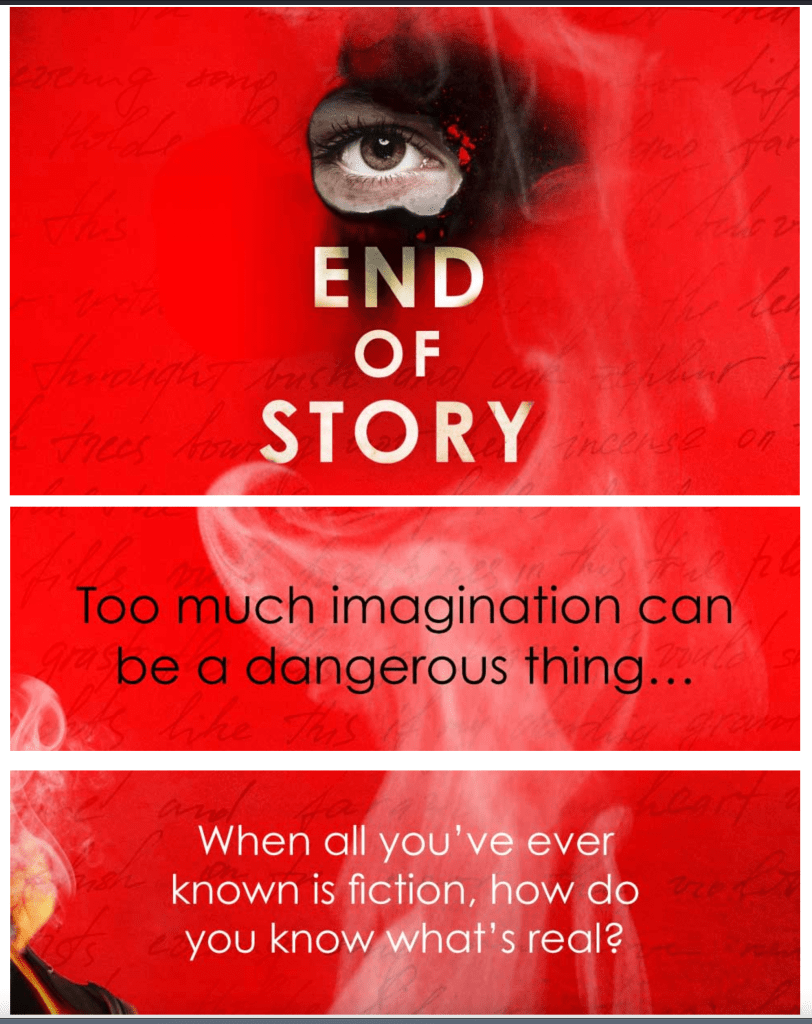
No publisher will be interested in a book where fiction is banned.
Again, I sort of understand the reasoning behind this one too. Publishers deal in books. Would a publisher even want to think about such a horrible idea? I’d already written End of Story at this stage and so it was hard to hear this. But, once again, it only prepared me for a possible fight. Ironically, that never came. It was only about a month from submission to signing a deal with Hodder for this novel, but in hindsight, this advice could have prepared me for the many usual knockbacks that come, ones I’d had thousands of times in the past.
Anyway, enough of me. You get the drift here … use knockbacks for push forwards. The very thing you’re being criticised for is what makes you you. Never lose that. Your originality is all you have. And one day, the right publisher(s) will hopefully come along…
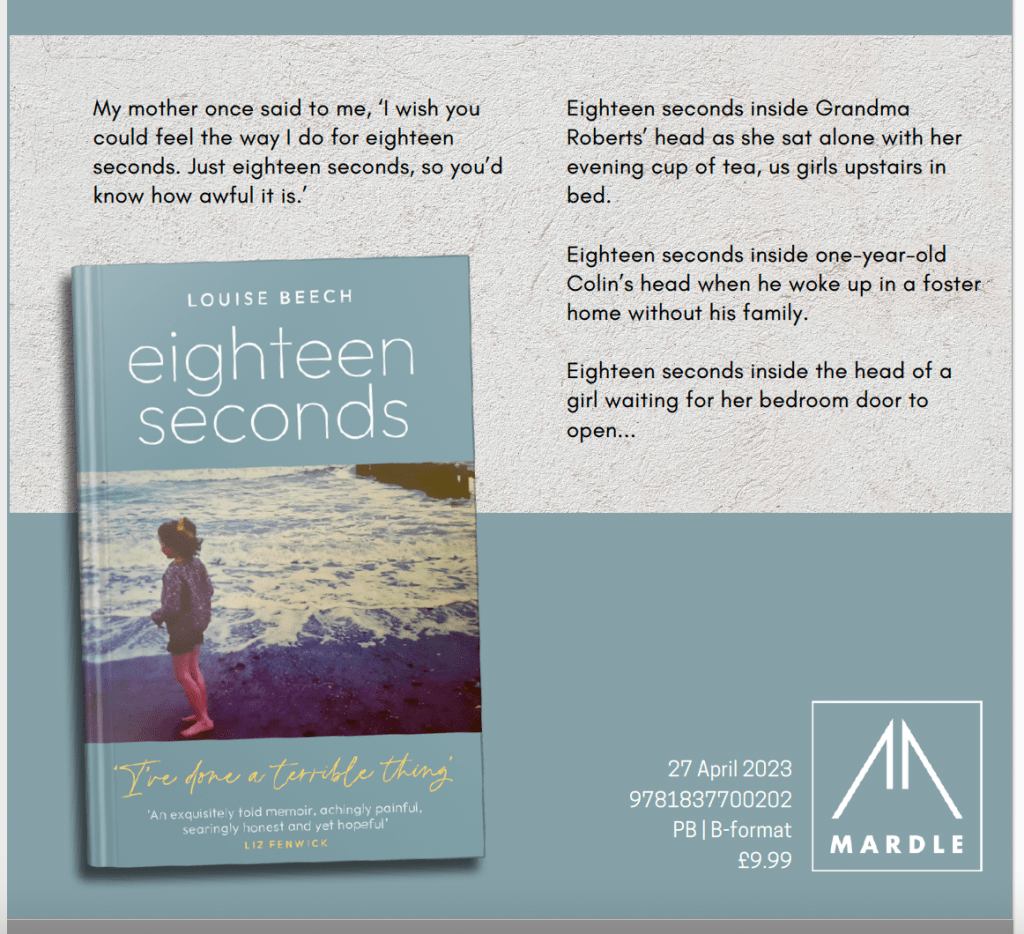
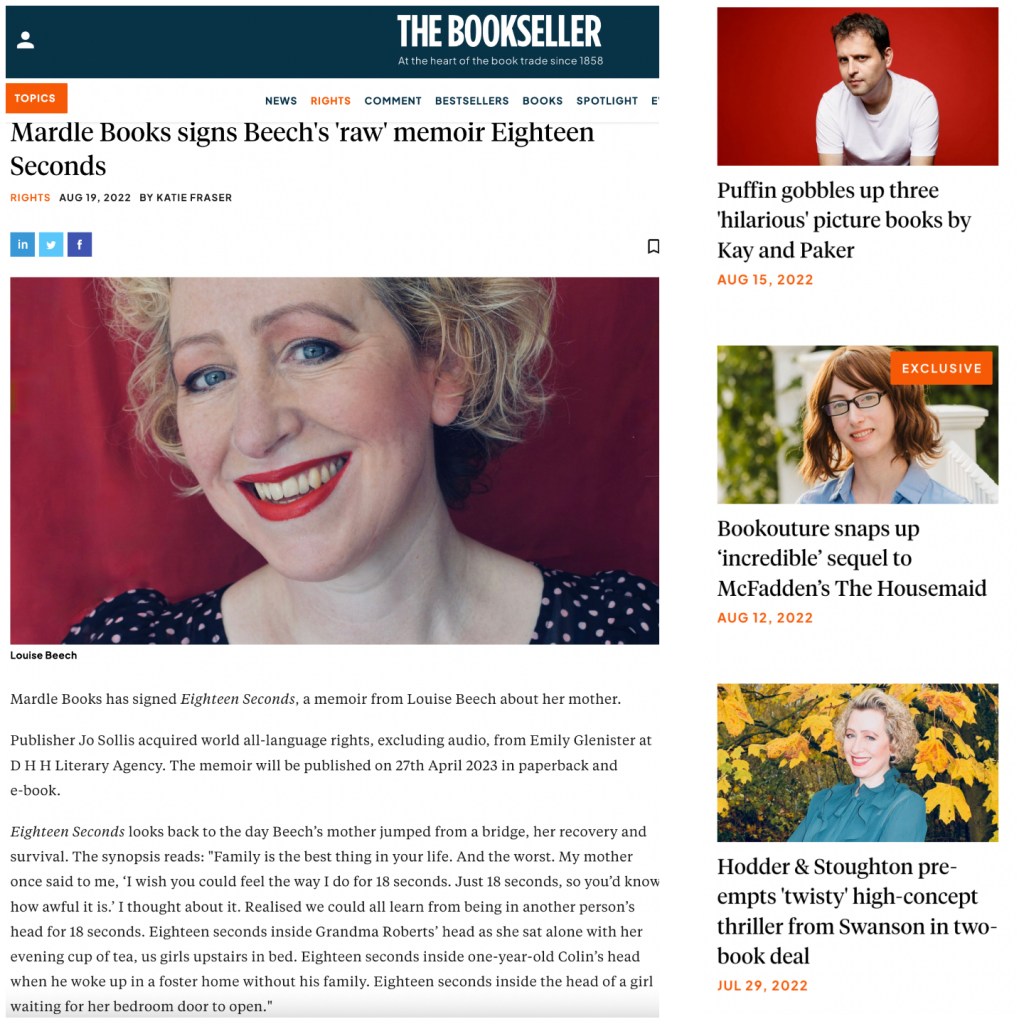
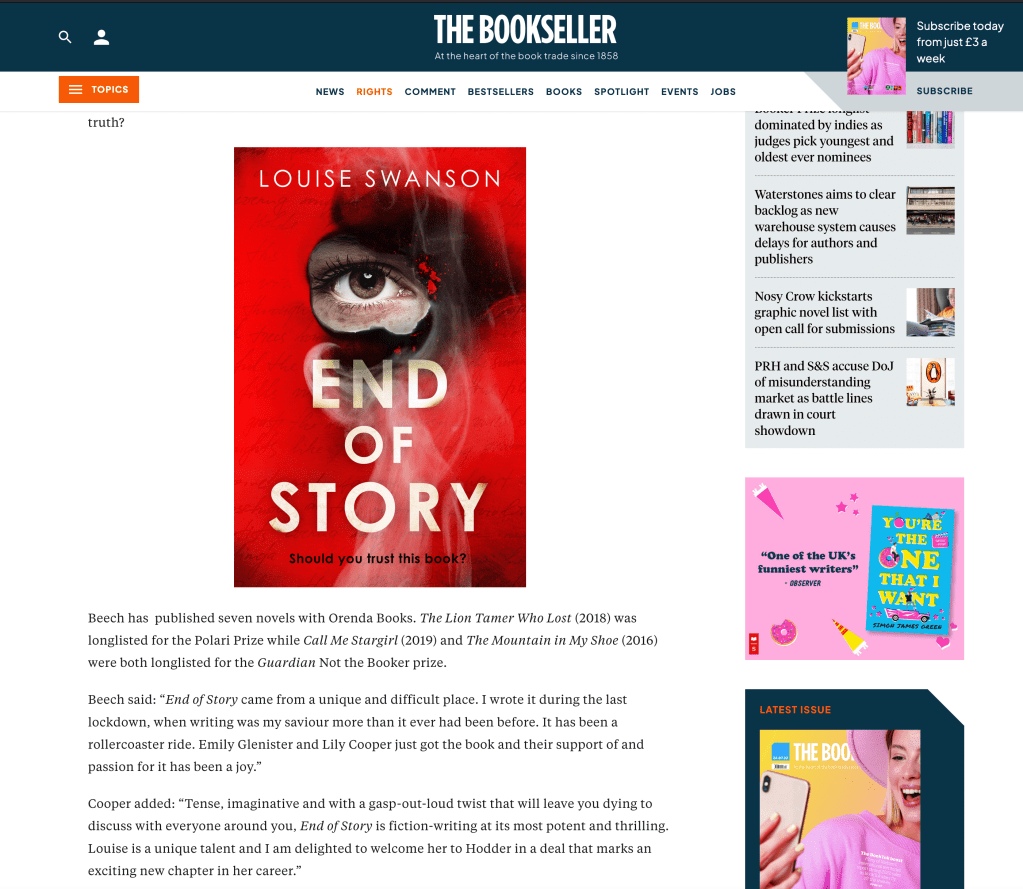
It’s been a month of really exciting announcements, one of which – the news that End of Story, my dystopian fiction, has been sold to Hodder – I waited over a year to shout about. Understandably, a few people were shocked that I could keep this mouth shut for that long. I am an enigma. A keeper of secrets. Ha. But now it is also out that my memoir, originally called Daffodils in audiobook, will be released next year. It’s now called Eighteen Seconds. Mardle wanted a less vague, more memoir-ish title, and I chose Eighteen Seconds because of a certain chapter with this title that many audiobook listeners told me had touched them. Obviously, the daffodils are still a huge part of the story, that hasn’t changed. Both books are out in 2023.
What struck me last night as I digested all this exciting news, was how close the release dates of these two books are. End of Story will be released 23rd March, and Eighteen Seconds (almost typed Daffodils!) is out 27th April. Just five weeks exactly between them. Which is exactly the time I took between writing them. I finished Daffodils, as it was then called, at the beginning of May 2020 as we came out of the first lockdown, and started End of Story mid-June. I continued writing that one through the final and darkest lockdown at the end of 2020. It feels perfect that though it’s the other way around (I wrote End of Story after Eighteen Seconds, but it will be first) they belong almost side by side. I could not have written End of Story if I hadn’t gone through the cathartic, painful, and full-on experience of writing a memoir.
At first, I was very scared though. Someone said to me that if I wrote my memoir, I might never write anything again. I’m not quite sure what the thinking was behind it – maybe that I’d be spent, done, have written everything I was supposed to. This might have put anyone off both starting the difficult task of writing their own story, and then trying to write a fiction afterwards. But anyone who knows me knows that suggesting I don’t do something is the wrong way to stop me. I trust only my gut instinct. It never lets me down. And when I had poured my own story onto the page, after a brief five-week breather, I was ready – though obviously nervous – to start what felt like my most epic book, a dystopian novel exploring a future world where all fiction is banned. The fear that I might never write again compelled me to write harder, better, with more self-critcism.
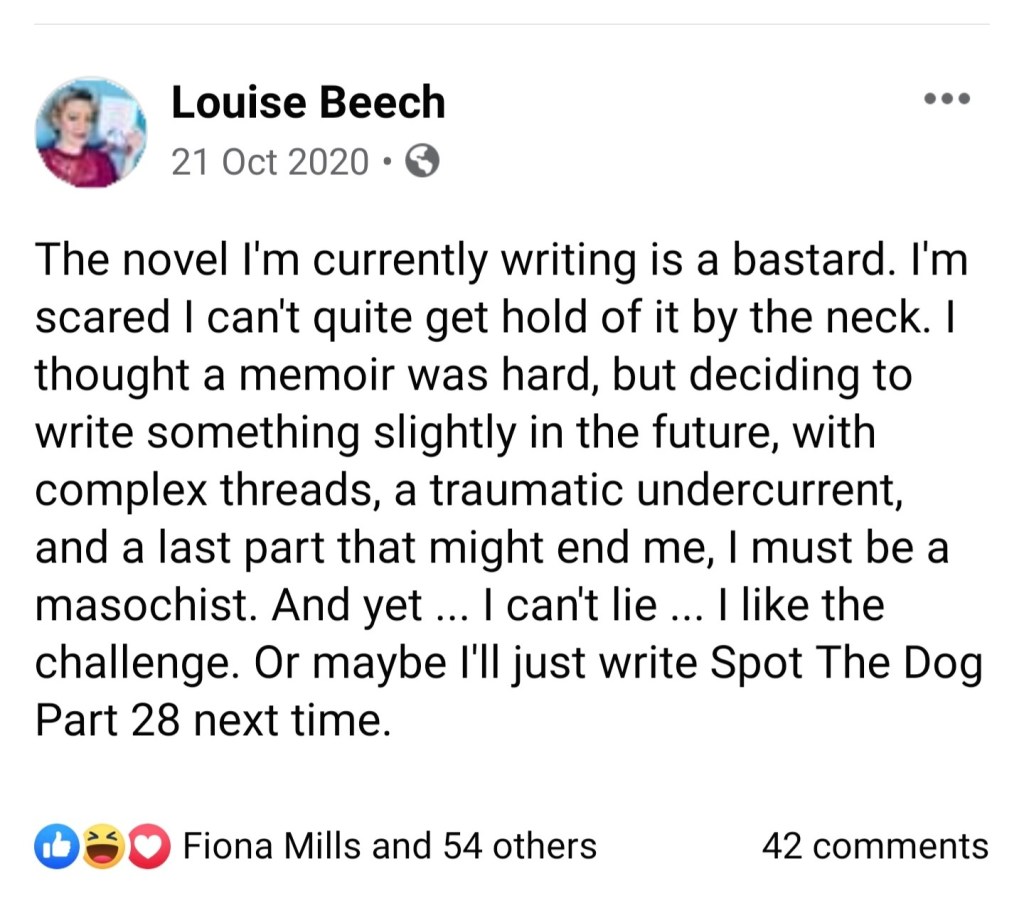
Words I shared on Facebook while writing End of Story..
As you can imagine, I’m delighted that both books will be on shop bookshelves next year. Two of my proudest achievements, each written during what were unprecedented times. And though the memoir is my own truth, there’s a lot of that in End of Story too, a novel that explores themes of grief, loss, isolation, and the absolute power of the arts to heal and uplift and unite. Look out for the cover for Eighteen Seconds in the near future. I can’t wait. Huge thanks to Emily Glenister for getting me these wonderful book deals.
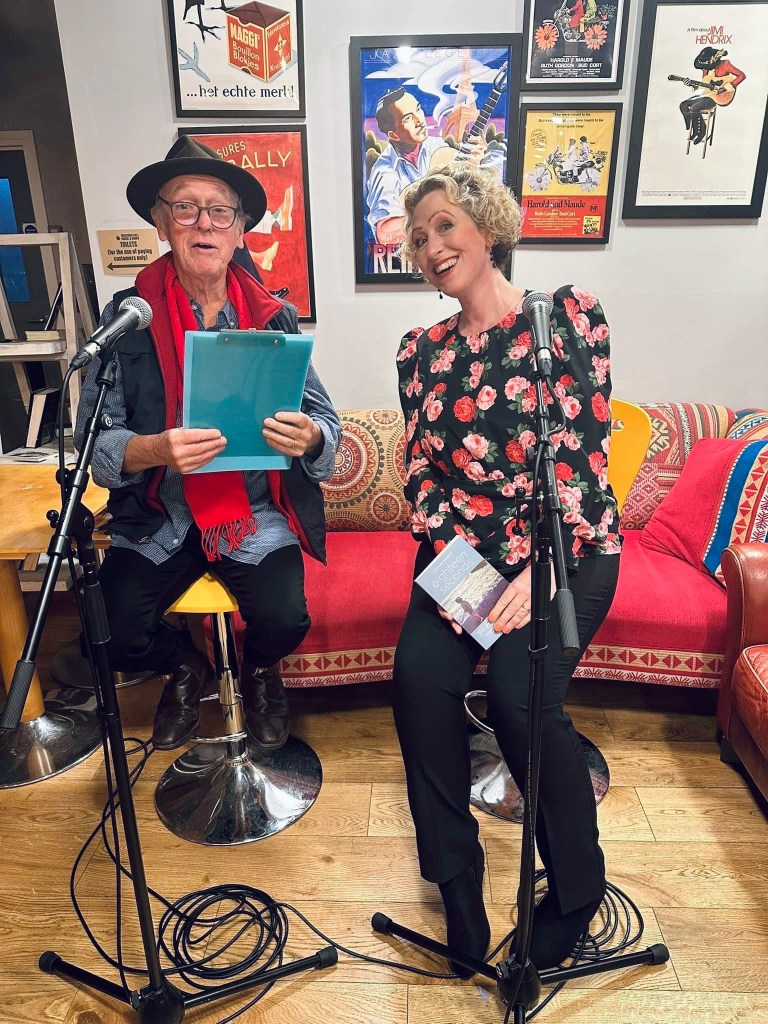
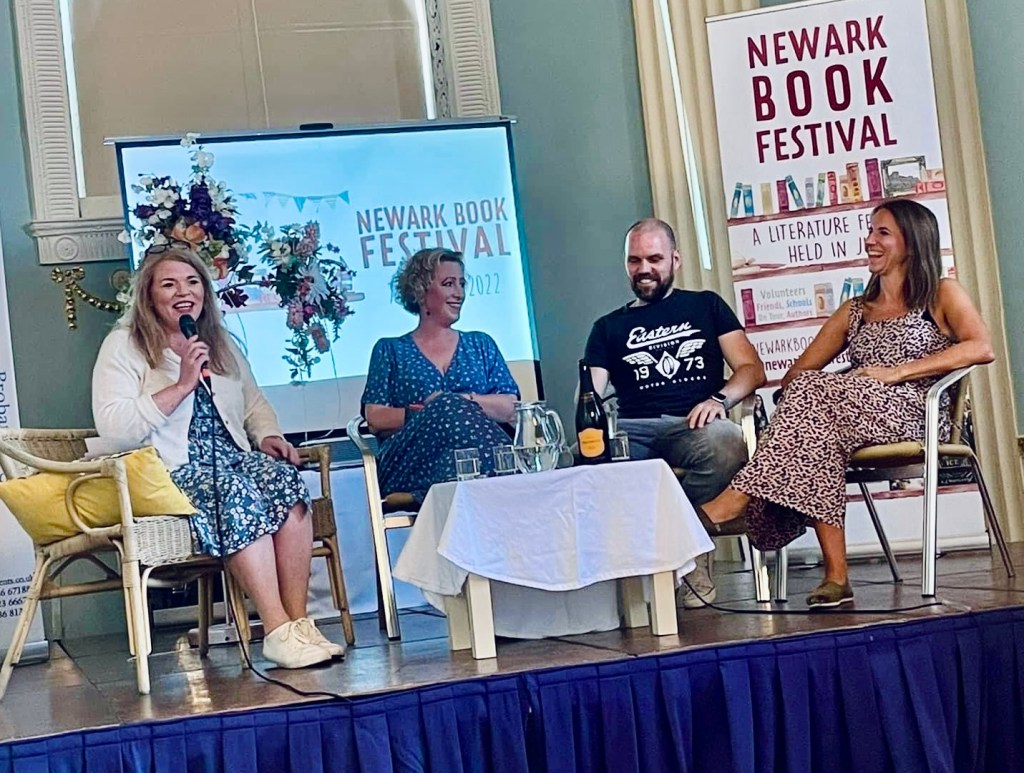
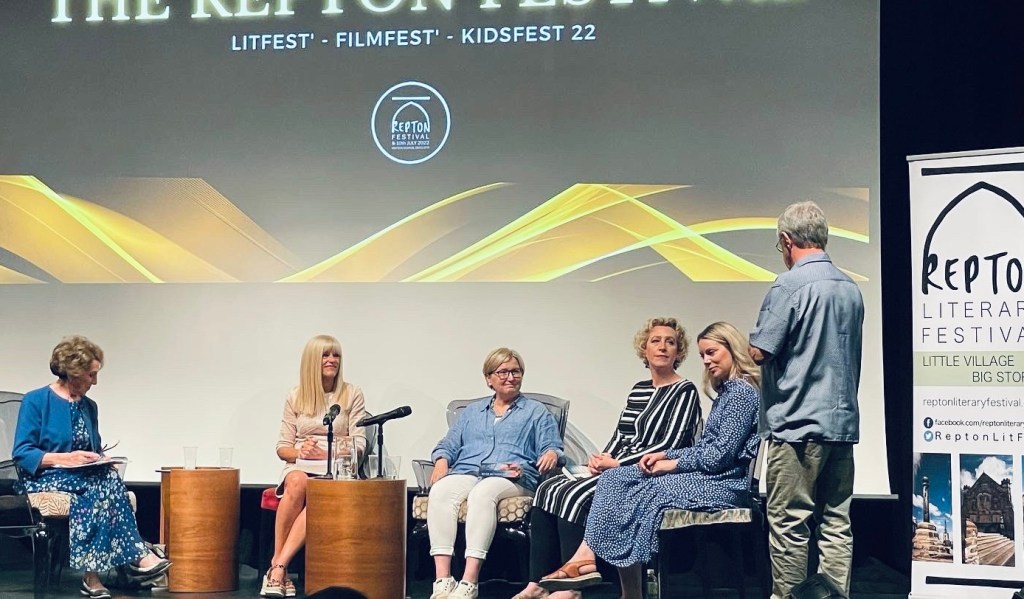
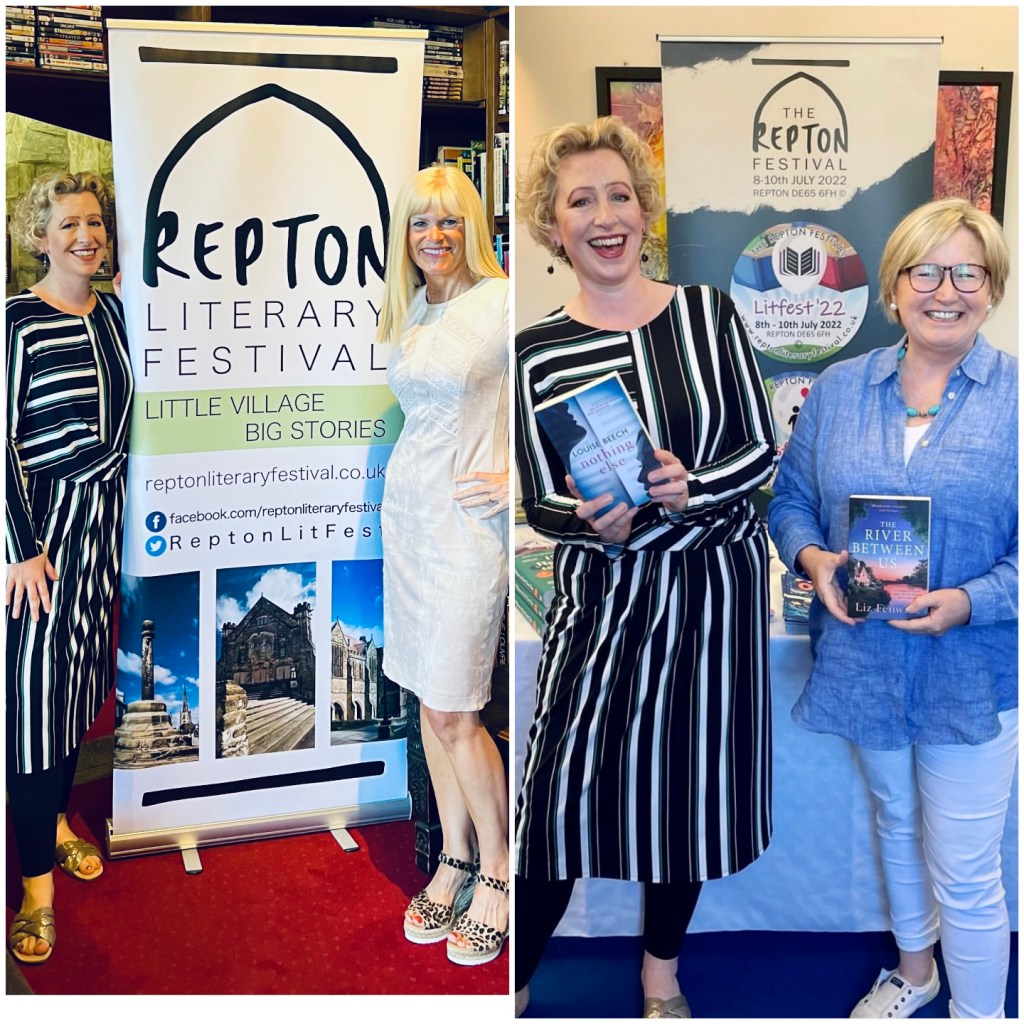
After a week of book panels, I came home exhausted but bouyant. It was wonderful to mix with actual humans like it was the ‘old world’ again, to meet new readers and old, to work alongside authors and reunite with loyal bloggers, and to see some fantastic festivals full swing once more, with people milling about, books exchanging hands, conversation passionate. I did a panel with Karen Sullivan, Will Carver and Sarah Sultoon at Newark Book Festival, in their gorgeous town hall on the market square, for a receptive audience who looked just as happy as I felt to be doing this again. Then it was onto Repton Literary Festival for two panels, one in Repton School’s beautiful 450-year-old library, with stained glass windows and dark wood everywhere, and one in the huge school theatre.
There, I did a couple of panels with crime writer Caroline England, and one with the Queen of Cornish, Liz Fenwick. In between these, conversation got around to the writing community in general, and how supportive it is. One audience member had asked if there was competition between authors, since books were competing for attention, advertising and sales. We all agreed that the answer, in general – of course there will always be the exception – was no. That writers truly support one another. They do. Caroline said that when she was first going to a major crime festival, and nervous, I’d told her, ‘Look for me, I’ll always chat.’ I’d forgotten this. But I will. Always.
Liz said that she likes particularly to support debut novels, and will make time to read and share reviews of those. ‘We all know how hard it is, starting out as a new author,’ she said. ‘So I like to help in any way I can.’ Similarly, I try and support indie and smaller publishers. If I receive an ARC (Advance Review Copy) from one of them, I’ll put that nearer to the top of my reading pile. I make time for emerging writers who ask me questions at festivals such as these, remembering well what it’s like to be desperate for that elusive book deal. There is room for everyone in the writing community and most authors I’ve met are very welcoming. As I said to Caroline, if you see me at an event, I’m super down to earth and will always make time to chat to you.
I saw a recent post on Twitter about people feeling uncomfortable attending literary events – the tweeter had insisted that they shouldn’t, that she hadn’t read all the ‘classics’ and was often just there to gush. I loved this. That’s what it should be about. Passion. Love of books. I hate the snobbery that can often be wrapped up in all things literary. Coming from a working class background, I sometimes feel out of place, like I shouldn’t be on a platform with these well-educated and successful authors. Then I have a strong a word with myself. I deserve it as much as anyone else. So, remember – authors get anxious too. I feel sick before every panel I do. Thank God then that the writing community is as supportive as it is. That most authors leave the ladder down for those behind them.










 Louise Beech/Louise Swanson